OpenAI and Epic integration brings AI healthcare into EHR workflows, connecting patient records with ChatGPT for Healthcare to advance research and patient care.
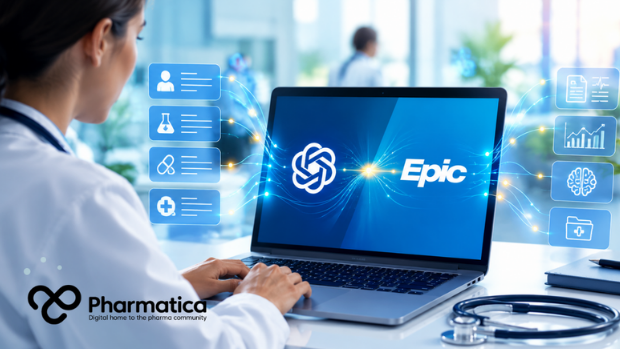
AI in healthcare has moved closer to the clinical workflow as OpenAI connects ChatGPT for Healthcare with authorised Epic electronic health record data, signalling a broader shift from standalone AI tools towards governed systems that can bring patient records, medical evidence, clinical trials, and healthcare data into one working environment.
Image
OpenAI Brings EHR Context into ChatGPT
OpenAI announced new Epic integration on 01 September 2026, allowing approved healthcare organisations to connect authorised patient information to ChatGPT for Healthcare.
The integration is designed to help clinical teams review information already available to them without manually searching across multiple sections of an electronic health record (EHR).
Healthcare data is abundant, but it remains fragmented across clinical notes, laboratory results, medication histories, specialist documentation, research databases, and operational systems.
AI can only create useful outputs when it can access the right information in the right context.
The strategic integration is therefore less about adding another chatbot to healthcare and more about connecting AI to the data infrastructure where healthcare work already happens.
OpenAI says clinicians can use the integration interface to ask questions such as what has changed since a patient’s previous visit, which laboratory results need attention, whether medications have changed, and whether specialist recommendations or follow-up actions remain unresolved.
The system can then summarise relevant information and point users back to supporting chart information.
The integration supports two related models. Healthcare teams can bring authorised EHR context into ChatGPT, or, in supported deployments, access ChatGPT capabilities within the EHR workflow itself.
The two models are important for adoption. A standalone application requires users to change their behaviour, while an AI capability embedded into an existing workflow has a much lower operational barrier.
This could really help with better care delivery and pharma development.
Clinical development teams increasingly depend on data generated inside healthcare systems. Recruitment, trial feasibility, real-world evidence, safety monitoring, disease understanding, and post-market research all depend on access to high-quality clinical information.
The closer AI gets to the source of that information, the greater its potential value.
“This is one of the riskiest industries there is because you're dealing with human lives, you're dealing with experimental protocols, and you're dealing with regulatory bodies where you might not get another shot at that clinical trial."
Image
OpenAI and Epic Integration: From Patient Records to a Connected Healthcare Data Layer
The Epic integration was only one part of OpenAI’s announcement.
OpenAI has also introduced a Healthcare Public Data plugin that provides structured access to nine official healthcare sources, including PubMed, ClinicalTrials.gov, DailyMed, CMS Coverage, and RxNorm.
This creates a more interesting model than simply asking an AI system to summarise a patient record.
A healthcare professional could potentially work across several information layers:
Patient context: authorised EHR information.
Medical evidence: published research and clinical literature.
Clinical trials: active studies and eligibility information.
Medicines: drug identifiers, labels, and safety information.
Coverage: healthcare and reimbursement information.
The value comes from connecting these layers.
Consider a clinical development scenario. A research team may need to understand the characteristics of a patient population, identify relevant studies, review eligibility requirements, examine current treatment information, and compare findings with published evidence.
Today, those tasks often require multiple systems and searches.
A governed AI workspace could potentially bring those information sources together and reduce the time required to move between them.
Image
That does not mean that AI is the decision-maker. However, AI would be the interface through which professionals interrogate increasingly complex healthcare data environments.
The advantage doesn’t come from owning the most sophisticated model. Instead it’s from having the cleanest, most accessible, best-governed data environment around that model.
Pharmatica has previously examined this issue in the context of EHR patient recruitment, where the challenge is not simply matching patients to trials. Data quality, interoperability, workflow integration, and evaluation determine whether the technology creates operational value.
The OpenAI-Epic development points towards the same principle at a much broader scale.
A Busy Time for OpenAI in Healthcare
The OpenAI and Epic integration may present an opportunity outside the immediate clinical workflow.
Drug development generates and consumes information across a long chain. Patient records inform research questions, clinical trials generate structured and unstructured data, published evidence influences protocol design, regulatory requirements shape evidence standards, and commercial teams later depend on real-world information to understand treatment patterns and patient populations.
These activities are often managed through separate technology environments.
AI could provide a connective layer between them.
That could affect several areas of pharmaceutical development.
Clinical trial recruitment
EHR data can help identify patients who may meet trial criteria. AI can potentially assist with interpreting unstructured notes and finding relevant information that conventional structured queries miss.
However, Pharmatica’s recent analysis of EHR-supported recruitment shows why this opportunity should not be reduced to automated matching. A review of 44 evaluations found major gaps in workflow integration, data transformation, notification, and end-to-end assessment.
The next generation of systems therefore needs to connect data, eligibility logic, clinical workflows, and research operations.
Evidence generation
Connecting patient context with published research could support faster evidence review and hypothesis development.
Researchers could potentially move from a patient-level question to relevant literature, trial information, or treatment data without manually searching each source.
That could be valuable in rare diseases, oncology, and complex conditions where clinical information is distributed across multiple specialties.
Clinical development intelligence
Pharma teams could also use connected healthcare data to understand how disease, treatment, and clinical practice interact.
This could strengthen feasibility assessments, protocol planning, endpoint strategy, patient segmentation, and real-world evidence programmes.
Pharmatica’s analysis of digital health technologies in clinical drug development highlights a similar transition. The opportunity is not simply to collect more data. Sponsors need to establish whether digital information is sufficiently valid, standardised, and meaningful to support development decisions.
The same principle applies to generative AI.
More connected information does not automatically mean better evidence.
AI in Pharma: Why the Future of Healthcare Starts With Patients, Not Tech
Kate O’Reilly, President & Chair of the Healthcare Businesswomen’s Association (HBA) Dublin-Ireland Chapter & Healthcare Transformation Partner at Roche, discusses AI in pharma, patient engagement, and the future of healthcare innovation.
Image
Governance Is Important for AI Integration in Healthcare
OpenAI's announcement puts considerable emphasis on governance.
ChatGPT for Healthcare operates within a governed workspace with controls including role-based access, single sign-on, and audit logs. OpenAI also states that organisations using protected health information need an applicable Business Associate Agreement and appropriate configuration.
The Epic integration is currently read-only. It does not update medical records, place orders, message patients, or override existing permissions. Users remain responsible for reviewing the underlying record and making clinical decisions.
These controls determine whether an AI system can operate safely inside regulated healthcare environments.
On the regulatory side, the U.S. Office of the National Coordinator for Health Information Technology’s HTI-1 final rule introduced transparency requirements for AI and predictive algorithms used in certified health IT, alongside broader measures supporting interoperability and information exchange.
For pharmaceutical development, the U.S. Food and Drug Administration (FDA) is also moving towards a risk-based approach to AI. Its 2026 guiding principles for AI in drug development emphasise human-centric design, data governance, clear context of use, multidisciplinary expertise, performance assessment, and lifecycle management.
The FDA’s 2025 draft guidance on AI supporting regulatory decision-making similarly proposes assessing model credibility according to its specific context of use, emphasising that AI governance cannot be engineered onto a model only after deployment.
Data permissions, traceability, validation, human oversight, model monitoring, and defined use cases need to form part of the architecture from the beginning.
Image
The Opportunity Is Bigger than a Chatbot
OpenAI reports that physicians evaluated connected EHR responses across 27 clinical use cases. Across 4,363 ratings, the responses were rated safe in 99.1% of cases.
In a separate evaluation, more than 93% of responses were rated as having “good” or better accuracy across each of five connected data sources tested.
These figures are notable, but they should be interpreted carefully.
They are OpenAI-reported evaluations, not independent evidence that the system is clinically safe for every use case or healthcare environment. The performance of an AI system can vary with data quality, workflow, configuration, user behaviour, and the specific task being performed.
For those considering similar technologies, they should assess the data source, context of use, model performance, human review, auditability, privacy controls, integration architecture, and lifecycle monitoring as one system.
The OpenAI and Epic integration suggests that healthcare AI is moving towards connected intelligence rather than isolated applications. The model becomes the reasoning interface, while EHRs, research databases, clinical-trial registries, medicine databases, and organisational systems provide the underlying context.
That architecture could eventually support a more connected development ecosystem.
Clinical research teams could work with patient and trial information; medical teams could connect evidence with treatment data; real-world evidence groups could interrogate larger information environments, and commercial teams could connect clinical knowledge with coverage and population data.
The value will depend on how well those systems connect without compromising data governance or scientific judgement.
Pharmatica’s broader Digital Pulse analysis tracks this shift across AI, digital health, data infrastructure, and pharmaceutical innovation.
Pharmatica considers where AI should sit within an organisation’s information architecture, what data it should be allowed to access, and which decisions it can safely support. That is where the next phase of healthcare AI will be won.
Pharmatica: Insight. Connection. Impact.
Frequently Asked Questions
What is the OpenAI and Epic integration?
The OpenAI and Epic integration allows approved healthcare organisations to connect authorised Epic electronic health record information with ChatGPT for Healthcare. The current integration is read-only and supports review of clinical information within approved permissions.
How can AI use EHR data in healthcare?
AI can analyse authorised EHR information to summarise clinical histories, identify changes, review medications and laboratory results, and surface relevant information for professional review. The usefulness of these outputs depends on data quality, workflow design, permissions, and human oversight.
What healthcare data sources can ChatGPT access?
OpenAI’s Healthcare Public Data plugin provides structured access to nine official healthcare sources, including PubMed, ClinicalTrials.gov, DailyMed, CMS Coverage, and RxNorm.
What does OpenAI's Epic integration mean for pharma development?
The integration points towards a more connected healthcare data environment that could support clinical research, patient-trial matching, evidence generation, feasibility assessment, and real-world data analysis. Pharma organisations will still need appropriate governance, validation, privacy controls, and human oversight.
Is AI in healthcare ready for regulated pharmaceutical workflows?
AI adoption is increasing, but readiness depends on the specific context of use. FDA guidance emphasises risk-based assessment, data governance, model performance, human-centric design, and lifecycle management rather than treating AI as a single technology category.
Nicole (BSc Molecular Medicine, Honours Medical Biochemistry) has many years of pharmaceutical experience, having worked for top CROs and biopharma companies for more than a decade.
Did you enjoy the content?
3
Why not support
Nicole Dale
by giving this content a like
Designing Decentralised Clinical Trials for Patient Diversity
Data shows that most DCT approaches significantly improve patient diversity. This analysis examines what the evidence means for clinical trial design strategy.
Decentralised clinical trials promise to transform drug development and pharma strategy. The evidence tells a complex story. Here is what’s working and what still needs to be fixed.
Ethical obligations in decentralised clinical trials extend beyond consent and privacy. Sponsors must protect safety, scientific validity, equity, and oversight.
Select the Right Data Collection Method for Real-World Evidence
Choosing the wrong RWE data source undermines your regulatory strategy. This framework helps pharma leaders select the right real-world data collection method based on your programme’s research question.
Cell Therapy for Solid Tumours: Current Challenges and New Advances
Cell therapy for solid tumours faces unique biological barriers. This analysis unpacks the engineering strategies pharma leaders must understand for R&D success in 2026.
Why Gynaecological Cancers Are Some of Pharma’s Most Important Challenges
Gynaecological cancers remain a major pharma challenge. Explore how disease burden, access, tumour biology, and precision medicine are shaping oncology R&D.













Comments (0)