Anthropic AI for Science now supports 20 scientific partners worldwide. Discover what its expanded research network means for pharmaceutical R&D and drug discovery.
Anthropic’s AI for Science programme is bringing major scientific foundations, research institutions, and specialist initiatives into a growing network of AI-supported discovery.
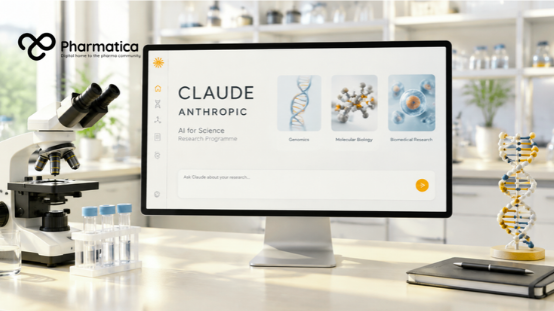
The recent October 2026 expansion provides Claude credits to 20 organisations, with potential implications for genomics, biomedical research, drug discovery, and the wider scientific infrastructure supporting pharmaceutical innovation.
Image
Anthropic AI for Science Programmes Bigger Than Individual Scientists
On 28 October 2026, Anthropic announced an expansion of its AI for Science programme through partnerships with 20 scientific foundations, institutions, and research initiatives worldwide.
The programme provides free Claude credits to support researchers working on scientific projects with significant potential.
It aims to make advanced AI capabilities more accessible while helping research teams investigate complex problems across multiple disciplines.
Anthropic launched the initiative in May 2025. Since then, it says it has supported hundreds of projects spanning biology, medicine, physics, chemistry, climate science, and mathematics.
The latest announcement marks an important change in its approach. Rather than concentrating primarily on individual scientists, Anthropic is working with organisations that already manage research funding, scientific infrastructure, specialist datasets, and established research communities.
That sort of change is important. Access to AI is only one part of scientific progress. Researchers also need reliable datasets, specialist knowledge, experimental infrastructure, and the ability to test computational findings in the laboratory.
Anthropic’s institutional strategy brings these elements closer together.
Reimagine AI-driven Drug Discovery with Pharma Superintelligence
Explore how AI-driven drug discovery is evolving through Pharmaceutical Superintelligence and what your organisation can do to keep up.
Six Research Funders Will Extend Access to Claude
The expansion includes six scientific foundations and organisations that will distribute Claude credits to researchers pursuing ambitious scientific projects.
These organisations include:
Alfred P. Sloan Foundation: Supports scientific research and education across science, technology, engineering, mathematics, and economics.
Simons Foundation: Funds fundamental research in mathematics and the basic sciences, including work through its Flatiron Institute.
Schmidt Sciences: Supports advanced research across biosciences, artificial intelligence, astrophysics, climate, and space.
Open Source for Science Fund: A Renaissance Philanthropy initiative supporting the open-source software infrastructure used in scientific research.
U.S. National Science Foundation: A major federal research funder supporting scientific discovery and education across numerous disciplines.
CAS: An American Chemical Society division that maintains extensive chemical literature and substance identification resources.
Image
For pharmaceutical researchers, CAS is particularly relevant. Its chemical information infrastructure supports the identification and analysis of substances across scientific and industrial applications.
The wider significance of Anthropic’s AI in Science lies in the distribution model. Established funding organisations can connect AI resources with researchers who already have defined scientific objectives, rather than relying entirely on individual applications or commercial subscriptions.
However, Anthropic has not disclosed the total financial value of the credits allocated to these partners or how much each organisation will distribute. The announcement therefore establishes an expansion in access, rather than a quantified research investment.
Genomics and Biomedical Research Take Centre Stage
Six research institutions will use Claude credits within their organisations. Their scientific interests include genomics, molecular biology, biomedical research, and computational life sciences.
The participating institutions are:
Space Telescope Science Institute: Provides scientific infrastructure and data resources supporting major space telescope research.
Wellcome Sanger Institute: Conducts large-scale genomic research spanning human genetics, biodiversity, and drug development.
Francis Crick Institute: Investigates the biological mechanisms underlying health and disease.
Imperial College London Department of Life Sciences: Conducts research across molecular biology, health, disease, and environmental science.
European Molecular Biology Laboratory (EMBL): Supports experimental and computational life sciences research, including major resources through EMBL’s European Bioinformatics Institute.
Gladstone Institutes: Integrates AI and data science into research covering cardiology, neurology, infectious diseases, cancer, and autoimmune conditions.
The Wellcome Sanger Institute partnership is particularly relevant to pharmaceutical innovation.
Large-scale genomic research generates complex datasets that can help scientists investigate disease mechanisms, identify genetic associations, and improve understanding of biological variation.
EMBL-EBI also provides important infrastructure through resources such as Ensembl, the Protein Data Bank in Europe, and Europe PMC. These resources support research across genomics, structural biology, and biomedical literature.
For drug discovery teams, the opportunity is not simply faster access to information.
AI-assisted analysis could help researchers connect findings across large datasets, investigate relationships between biological systems, and develop hypotheses for further experimental investigation.
Nevertheless, identifying a promising association is not equivalent to establishing a therapeutic target. Experimental confirmation and biological interpretation remain essential.
Image
Six Research Initiatives Target Specific Scientific Challenges
Anthropic is also supporting six specialist research projects with direct Claude credit allocations.
Several have clear relevance to pharmaceutical and biomedical research.
The Genome Aggregation Database (gnomAD), developed by the Broad Institute, brings together genetic information from more than 800,000 people.
Researchers and clinical laboratories use this resource to investigate human genetic variation and support rare disease research and diagnosis.
The Centre for Population Genomics, a joint initiative involving Australia’s Garvan Institute of Medical Research and Murdoch Children’s Research Institute, focuses on improving representation within genomic resources and developing tools for rare disease diagnosis.
Other initiatives include:
AstroPath: A Johns Hopkins University cancer research project that applies imaging and measurement approaches from astronomy to the analysis of tumour tissue at cellular resolution.
FlyWire: A Princeton University neuroscience initiative mapping neural connections and developing open resources for understanding brain circuitry.
LEAP: A Columbia University research centre combining AI and physics to improve Earth system modelling.
Tau Ceti: An open mathematical research initiative developing computer-verifiable mathematical proofs.
The diversity of these projects illustrates Anthropic’s wider ambition. It is positioning Claude as a research assistant across scientific disciplines, rather than restricting its applications to conventional business productivity.
First Quarter 2026 State of Digital Health Funding
Digital health funding hit $7.4B in Q1 2026, the highest since Q2 2022. The CB Insights State of Digital Health report reveals where capital is concentrating and why it matters for pharma leaders.
Image
What Anthropic and Claude’s Expansion Means for Pharmaceutical R&D
The announcement follows Anthropic’s growing commercial and scientific involvement in life sciences, discussed in Pharmatica’s earlier Anthropic IPO analysis.
That article examined the company’s pharmaceutical customers, research ambitions, laboratory investments, and emerging role in drug discovery.
The AI for Science expansion adds another dimension: Building relationships with the scientific institutions and infrastructure that underpin pharmaceutical innovation.
Anthropic describes several potential applications for Claude, including hypothesis generation, experimental design, complex data analysis, and scientific communication.
Its earlier partnership with the Allen Institute also demonstrates how AI agents could support large-scale biological data analysis. The company describes a workflow intended to reduce analysis that previously took months to a matter of hours.
This direction connects with wider developments in AI-assisted drug discovery, including the growing use of computational methods to investigate biological targets and molecular structures.
Pharmatica’s coverage of the AI black box problem in drug discovery examines why scientific interpretability remains important as these systems become more influential.
However, access to Claude does not automatically establish scientific accuracy, improve clinical outcomes, or shorten drug development timelines.
AI-generated hypotheses still require expert assessment, reproducible experiments, and appropriate validation.
Anthropic also acknowledges that many of its new collaborations remain at an early stage. It has not yet published quantified results demonstrating the impact of this particular expansion.
The longer-term opportunity may lie in the resources these partnerships create.
Anthropic expects many projects to contribute open datasets, open-source software, shared technical standards, and scientific libraries.
These resources could benefit researchers beyond the participating organisations, provided that projects deliver accessible outputs.
The important development is therefore not simply the distribution of free AI credits, but it is the growing integration of AI providers into the scientific ecosystem, from computational research and genomics to laboratory infrastructure.
At Pharmatica, we examine the Technologies, Partnerships, and Scientific Developments influencing pharmaceutical R&D. Our Insights connect AI innovation with the evidence, infrastructure, and decisions that will determine its real-world value.
Pharmatica: Insight. Connection. Impact.
Frequently Asked Questions
What is Anthropic's AI for Science programme?
Anthropic’s AI for Science programme provides Claude credits and other AI resources to researchers working on scientific projects. It supports research across biology, medicine, chemistry, physics, mathematics, and other disciplines.
How many organisations are included in Anthropic's October 2026 expansion?
Anthropic announced partnerships involving 20 scientific foundations, institutions, and research initiatives worldwide. Its announcement provides named examples across funding organisations, institutions, and specialist projects.
How could Claude support pharmaceutical research and drug discovery?
Claude can assist researchers with scientific literature analysis, hypothesis generation, experimental planning, and complex data analysis. Scientists must still assess its findings and confirm research outcomes experimentally.
Which organisations are using Anthropic AI for genomics research?
The Wellcome Sanger Institute, EMBL, the Broad Institute’s gnomAD initiative, and the Centre for Population Genomics are among the organisations and projects involved in the expansion.
Will Anthropic’s AI for Science programme accelerate drug development?
The programme could improve research productivity and access to scientific resources. However, Anthropic has not yet demonstrated that this particular expansion reduces drug development timelines or improves clinical success rates.
Nicole (BSc Molecular Medicine, Honours Medical Biochemistry) has many years of pharmaceutical experience, having worked for top CROs and biopharma companies for more than a decade.
Did you enjoy the content?
3
Why not support
Nicole Dale
by giving this content a like
One Pivotal Trial for FDA Approval? Success Depends on Trial Design
One pivotal trial for FDA approval could accelerate drug development, reshape clinical trial strategy, and change the pharmaceutical regulatory landscape.
FAST-EU Pilot: Can Europe Finally Accelerate Multinational Clinical Trials?
The FAST-EU Pilot aims to accelerate multinational clinical trials through faster coordinated assessments, supporting Europe’s 2030 clinical research ambitions.
FDA clinical trial oversight is intensifying globally as the agency raises expectations for GCP, foreign site inspections, data integrity, and patient protection.
MHRA Updates GCP Inspection Guidance for ICH E6(R3)
The MHRA GCP inspection guidance now reflects ICH E6(R3) and the UK’s 2026 trials reform, with a new computerised systems dossier and clear TMF access rules.













Comments (0)