BMS and NVIDIA are building a powerful pharma AI factory using advanced supercomputing, AI models, and scientific data to accelerate drug discovery.
BMS and NVIDIA are scaling a new AI factory for drug discovery, combining NVIDIA Vera Rubin computing with BMS’s proprietary scientific data.
It’s not just the size of the supercomputer, but also the ability to turn high-performance computing, foundation models, and AI agents into a shared scientific infrastructure across the drug discovery pipeline.
Image
Why BMS Is Building a Pharma AI Factory
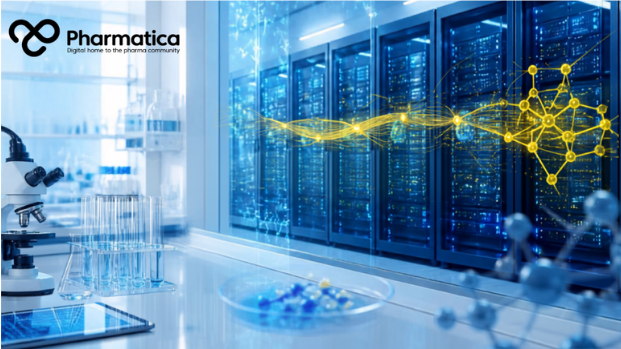
Bristol Myers Squibb is expanding its collaboration with NVIDIA with a new DGX SuperPOD built around eight DGX Vera Rubin NVL72 systems.
This will undoubtedly be the largest and most powerful supercomputer in pharma.
BMS says the infrastructure will provide its researchers with its most powerful and energy-efficient single-owned NVIDIA computing environment in life sciences.
The system is designed for workloads that conventional enterprise computing cannot handle at the same scale. These include training foundation models, running large predictions, exploring chemical space, and supporting agentic workflows.
More broadly in the industry, we’ve seen AI moving from isolated experiments into core pharmaceutical R&D.
AI applications in drug discovery span target identification, drug discovery, preclinical research, clinical development, and post-market surveillance.
BMS is therefore building infrastructure around this idea with a clear focus on what happens when AI becomes available as a shared scientific capability rather than a specialist tool.
“This is one of the riskiest industries there is because you're dealing with human lives, you're dealing with experimental protocols, and you're dealing with regulatory bodies where you might not get another shot at that clinical trial."
Image
From Pharma Supercomputer to Scientific Infrastructure
The new BMS NVIDIA supercomputer is not intended to operate as a standalone research machine.
BMS plans to combine the new Vera Rubin environment with its existing NVIDIA infrastructure into a more unified computing environment.
This is designed to give researchers across locations access to models, data, and computational resources without the same organisational and technical barriers that can fragment pharmaceutical R&D.
The underlying architecture is very important, as drug discovery generates multiple forms of information. Experimental results, molecular structures, clinical observations, imaging, and other proprietary datasets can become more valuable when they are connected.
BMS is also developing AI models trained on its proprietary scientific knowledge, while using NVIDIA BioNeMo capabilities for biological AI applications.
Nvidia BioNeMo supports model development across areas such as protein structure prediction, molecular generation, virtual screening, docking, and property prediction.
This creates a potentially powerful feedback loop:
Scientific data feeds models.
Models generate predictions.
Predictions influence experiments.
Experiments generate new data.
New data improves future models.
The objective is therefore not simply faster computing. It is faster organisational learning.
AI Agents Could Change How Drug Discovery Scientists Work
BMS is also moving towards what it describes as hybrid intelligence, where AI systems work alongside researchers rather than replacing them.
Its existing AI programmes include automated support for target identification and validation. BMS also uses a predictive approach before laboratory experimentation, allowing computational predictions to influence which molecules progress into experimental work.
The new infrastructure could expand this model considerably.
AI agents can potentially perform data-intensive tasks, compare evidence, execute computational workflows, and help researchers evaluate competing hypotheses.
NVIDIA’s BioNeMo Agent Toolkit is designed to give agents specialised tools across biology, chemistry, genomics, and drug discovery.
The core principle of the agentic AI is that drug discovery scientists remain responsible for scientific judgement, while AI handles more of the computational workload surrounding that judgement.
The Real Competitive Asset Is the Drug Discovery Data
The supercomputer will be impressive. But compute alone is unlikely to drive much value.
That’s where the data is needed. And BMS has it.
BMS has decades of proprietary research data, experimental knowledge, and clinical experience. The new infrastructure provides the scale to turn that information into reusable computational intelligence.
That will be important going forward. If every major company can access increasingly powerful AI hardware, competitive advantage may increasingly depend on the quality, integration, governance, and context of proprietary data.
This is consistent with the U.S. Food and Drug Administration’s (FDA’s) emerging approach to AI in drug development. Its 2026 AI principles emphasise data governance, documentation, context of use, risk-based performance assessment, and lifecycle management.
Pharmatica’s analysis of AI-driven drug discovery examines this wider transition from individual AI applications towards integrated discovery systems.
What BMS’s AI Factory Means for the Future of Drug Discovery
The BMS NVIDIA supercomputer shows how important R&D infrastructure is.
The winning model is not just AI added to drug discovery, but instead drug discovery redesigned around continuously available computational intelligence.
That raises difficult questions around model validation, proprietary data, cybersecurity, intellectual property, reproducibility, and regulatory credibility. The FDA's draft framework for AI supporting regulatory decisions already points towards risk-based assessment of model credibility for specific contexts of use.
BMS’s investment is therefore building more than simply computing capacity. It’s testing whether a pharmaceutical company can build a consistent AI learning system spanning drug discovery and development.
Pharmatica tracks this convergence of AI, scientific infrastructure, and pharmaceutical strategy, connecting technology adoption with the decisions that determine whether innovation translates into better R&D outcomes.
Pharmatica: Insight. Connection. Impact.
Image
Frequently Asked Questions
What is the BMS NVIDIA supercomputer?
BMS is deploying an NVIDIA DGX SuperPOD based on eight DGX Vera Rubin NVL72 systems to support large-scale AI workloads across pharmaceutical research and development.
What is BMS using NVIDIA AI infrastructure for?
BMS plans to use the infrastructure for foundation models, predictions, AI agents, biological research, molecule design, and other computational workloads across drug discovery.
What is an AI factory in pharmaceutical research?
An AI factory is an integrated computing, data, software, and AI infrastructure designed to continuously generate and deploy intelligence from large datasets. In pharma, this can support scientific prediction and experimentation.
How could the BMS AI factory accelerate drug discovery?
It can provide researchers with greater computing capacity for larger models, broader computational searches, predictive workflows, and AI agents that automate data-intensive scientific tasks.
Will AI replace pharmaceutical researchers?
BMS’s stated approach is hybrid intelligence. AI handles more computational work while scientists retain responsibility for scientific direction, interpretation, and judgement.
Nicole (BSc Molecular Medicine, Honours Medical Biochemistry) has many years of pharmaceutical experience, having worked for top CROs and biopharma companies for more than a decade.
Did you enjoy the content?
2
Why not support
Nicole Dale
by giving this content a like
What Drives Pharmaceutical R&D Success? New Benchmarking Reveals Why Some Drug Pipelines Outperform Others
Explore new benchmarking research on pharmaceutical R&D success rates, revealing why some drug pipelines consistently achieve higher approval rates than others.
Liver-Chip Supported Drug Discovery Moves to FDA Qualification
Liver-chip supported drug discovery is moving closer to regulatory acceptance as Emulate advances FDA ISTAND qualification for human-relevant DILI assessment.
EHR patient recruitment could improve clinical trial matching, but workflow integration, data quality, interoperability, and AI validation remain key challenges.
Enriched Clinical Trial Design: Who Gets Left Behind?
Enriched clinical trial design can improve trial efficiency, but may exclude patients from the evidence base. Explore the implications for clinical development.
RCT recruitment prediction can improve trial planning by using Poisson and Bayesian models to estimate enrolment rates, uncertainty, and recruitment risk.
Growing Patient and Public Involvement in Clinical Trials
Patient and public involvement in clinical trials improves study design. Learn why better reporting is essential for transparent, patient-centred research.






Comments (0)