The FDA’s AEMS platform consolidates adverse event reporting beyond just integrating FAERS. Explore its impact on safety signals and pharmacovigilance.
The launch of the U.S. FDA’s Adverse Event Monitoring System (AEMS) marked a significant change in how the agency consolidated and analysed adverse event reports.
Replacing the fragmented FAERS-era infrastructure with a broader monitoring platform, the transition aimed to improve access to safety information, strengthen surveillance, and make reporting data more useful across regulated product categories.
The change has implications for pharmacovigilance and regulatory oversight.
Image
From FAERS to AEMS: A Broader Safety Infrastructure
On 11 March 2026, the Food and Drug Administration (FDA) launched AEMS, its new platform for monitoring adverse events.
The system succeeds the FDA Adverse Event Reporting System (FAERS) for drug safety monitoring, while bringing together information previously held across several separate reporting systems.
The change addresses a longstanding operational issue. The FDA had processed approximately six million adverse event reports each year across seven databases.
These systems covered different product categories and operated with separate infrastructure, creating challenges for data access, analysis and agency oversight.
The FDA estimated that maintaining the previous platforms cost around U.S.D. $37 million annually. It projected savings of approximately US$120 million over five years through the new system.
AEMS is designed to consolidate adverse event reporting across human medicines, biological products, vaccines, medical devices, tobacco products, food, cosmetics and veterinary products.
The agency also intends to use AEMS for consumer complaints, regulatory misconduct reports, and whistleblower submissions.
This represents a broader approach to safety intelligence, with standardised reporting protocols, improved case-processing workflows, AI-supported redaction and digitisation, and enhanced analytics.
The agency’s objective is to make information easier to access and assess, while supporting surveillance across product categories.
What Changes for Adverse Event Reporting and Safety Signals?
The FDA’s relatively new AEMS platform changes how adverse event information is organised and made available.
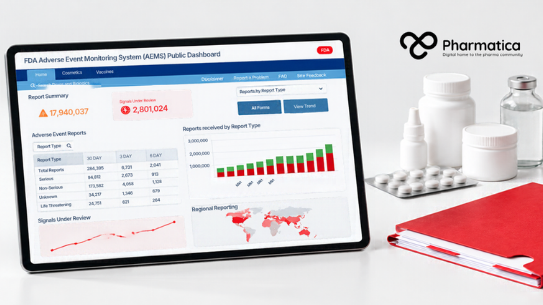
Its public dashboard gives users a more integrated way to search reports submitted by industry, healthcare professionals, and consumers.
The agency has also outlined a move towards more timely publication of reports.
Its March announcement described plans to make real-time adverse event information available across FDA-regulated product categories, with further data migration and technical developments following the initial launch.
This is intended to reduce reliance on older, fragmented systems and improve public access to safety information.
For drug safety and PV teams, the most important implications include:
More accessible safety information: A consolidated dashboard can make it easier for researchers, sponsors, and other stakeholders to examine reported events.
Greater analytical potential: Standardised information and improved analytics can help the FDA identify patterns across larger datasets.
More integrated surveillance: AEMS creates opportunities to examine safety trends across different product categories, rather than treating each reporting system in isolation.
Improved public transparency: Wider access to adverse event information can support scrutiny by healthcare professionals, researchers and patients.
However, greater visibility does not mean that every report represents a confirmed medicine-related risk.
AEMS contains reports of suspected adverse events, not verified evidence that a product caused an event. Reports may be incomplete, duplicated or influenced by factors unrelated to the medicine itself.
This point is essential when interpreting dashboard results or communicating potential safety concerns.
Find out how Quality-by-Design improves reliability and compliance in pharma and how you can maximise innovation through quality-based pharma development systems.
Quarterly Safety Signal Reporting Remains Important
The FDA’s page on new safety information and potential signals of serious risks explains how the agency will continue to communicate emerging concerns identified through AEMS data.
Under the existing statutory framework, the FDA publishes quarterly reports of potential serious safety signals identified wholly or partly through adverse event monitoring.
The requirement originates in the FDA Act of 2007 and was subsequently amended by the 21st Century Cures Act.
The FDA transferred data from FAERS to AEMS when the new platform launched on 11 March 2026 and potential signals identified through AEMS are now included in the report for the quarter in which they are first identified.
The distinction between a potential signal and an established safety risk is particularly important.
A product’s appearance in a quarterly report means the FDA has identified information that requires evaluation. It does not mean the agency has confirmed a causal relationship or concluded that the product is unsafe.
Following assessment, the FDA may decide that no regulatory action is necessary.
Alternatively, it may require changes to product labelling, introduce or modify a Risk Evaluation and Mitigation Strategy (REMS), request further evidence, or take more significant action, including suspension or withdrawal from the market.
This process reinforces the importance of interpreting safety signals in context. A report should prompt appropriate assessment, not an automatic conclusion about a product's risk profile.
Image
What AEMS Means for Pharmacovigilance and Drug Safety Teams
The transition from FAERS to AEMS has practical consequences for marketing authorisation holders, pharmacovigilance teams, and regulatory affairs leaders.
A more accessible reporting environment may make it easier for external stakeholders to identify emerging patterns, but it also increases the importance of disciplined safety-data interpretation.
Sponsors and drug safety teams should consider several areas.
Review safety intelligence and signal management
Pharmacovigilance teams should understand how AEMS data can complement their existing safety intelligence activities.
The public dashboard may provide useful context when assessing reported events, monitoring product safety, and reviewing information that could affect a product’s benefit-risk assessment.
However, spontaneous reporting data cannot establish incidence or prove causality. Report volume may reflect differences in exposure, reporting behaviour, publicity, or data quality.
Teams should therefore assess AEMS findings alongside clinical evidence, epidemiological information, literature, and their own safety databases.
Strengthen data quality and reporting oversight
A consolidated FDA platform does not remove the sponsor's responsibility to submit accurate, complete, and timely safety reports.
Sponsors should continue to examine their case-processing controls, reconciliation procedures, duplicate management, and reporting timelines.
The quality of information entering a safety system affects the quality of the conclusions drawn from it. Incomplete case details or inconsistent coding can complicate signal assessment, even when the underlying platform offers stronger analytical capabilities.
This also makes vendor oversight important. Companies outsourcing case intake, processing, or safety-database activities need clear responsibilities, effective quality controls, and evidence that outsourced processes meet regulatory expectations.
Prepare for greater scrutiny of safety information
A more accessible public reporting environment may increase attention on products associated with potential safety signals.
Companies should ensure that their medical, regulatory, communications, and pharmacovigilance teams can assess new information consistently.
This includes having clear escalation routes, documented medical review, and processes for deciding whether new evidence warrants further investigation or regulatory action.
Where safety findings affect ongoing development programmes, sponsors should also consider the implications for clinical monitoring and protocol management. Pharmatica’s coverage of clinical trial changes and protocol amendments explores how emerging evidence can translate into changes during development.
The Looming Threat of Geopolitical Risk in Clinical Supply Chains
Geopolitical risk is reshaping how clinical supply chains are managed, demanding resilience and foresight. Learn why building supply chain resilience is the key for clinical trial success.
Image
Consolidated Adverse Event Data Still Has Problems
AEMS offers a more integrated environment, but consolidation alone cannot resolve the scientific limitations of spontaneous adverse event reporting.
Reports may contain incomplete information, duplicate submissions, or uncertain product details.
A patient may experience an event while taking several concomitant medicines, and the report may not establish which treatment, underlying condition, or other factor contributed to it.
Additionally, reporting frequency can also rise following media coverage or public attention, without a corresponding increase in the underlying risk.
The FDA explicitly warns that the presence of a product in AEMS data does not establish that it caused the reported event. The dashboard should not be treated as a standalone measure of product safety.
For industry users, this means that better access to data must be matched by appropriate scientific interpretation.
For adverse event signals, detection remains the starting point for investigation. It does not replace clinical assessment, epidemiological analysis, or regulatory judgement.
The use of AI-supported tools also requires careful oversight. Automated redaction and digitisation may improve processing efficiency, but companies and regulators still need reliable controls for data accuracy, privacy and consistency.
Technology can support surveillance, but it cannot independently determine whether an association represents a clinically meaningful risk.
Image
AEMS Is an Important Safety Intelligence Tool
The FDA’s move from FAERS to AEMS is an important step in the modernisation of post-market safety surveillance.
Consolidating previously separate reporting systems, improving public access, and introducing more advanced analytical capabilities should give the agency a stronger foundation for monitoring potential risks.
For sponsors and development teams, the significance is more than the platform. AEMS makes it increasingly important to understand how external safety information is accessed, assessed, and incorporated into internal pharmacovigilance processes.
Companies should review their monitoring arrangements, maintain robust reporting controls, and ensure that emerging safety signals receive timely, evidence-based assessment.
The transition does not change the fundamental distinction between a reported event and a confirmed adverse drug reaction.
Nor does it transfer responsibility for product safety from manufacturers to the FDA. Sponsors remain accountable for their own safety systems, regulatory reporting, and benefit-risk assessments.
What is the FDA Adverse Event Monitoring System (AEMS)?
The FDA Adverse Event Monitoring System (AEMS) is a consolidated platform designed to collect, process, and analyse adverse event reports across multiple FDA-regulated product categories. It brings together reporting infrastructure that was previously spread across separate systems, including the former FAERS database for drugs and biological products.
When did AEMS replace FAERS?
The FDA launched AEMS on 11 March 2026, and drug-related data previously held in FAERS moved to the new platform on that date. AEMS is broader than a direct FAERS replacement because it is designed to consolidate reporting systems covering multiple product categories.
What types of products does AEMS cover?
AEMS supports adverse event monitoring across a wider range of FDA-regulated products, including prescription and non-prescription medicines, biological products, vaccines, medical devices, cosmetics, food, and tobacco products, as well as veterinary products. The platform is intended to support more integrated safety surveillance across these categories.
Does an AEMS report mean a medicine caused an adverse event?
No. An adverse event report records an event that occurred after a product was used, but it does not establish that the product caused the event. Reports may be incomplete, duplicated, or influenced by other factors, including underlying illness, concurrent medicines, and reporting patterns. FDA-listed potential safety signals require further assessment and should not be interpreted as confirmed risks.
What does AEMS mean for pharma and sponsors?
AEMS gives companies and safety teams another source of safety intelligence and makes public adverse event information more accessible. Pharma organisations should continue to maintain robust pharmacovigilance processes, monitor relevant safety information, assess potential signals in context, and ensure the quality and completeness of their own reporting. The public AEMS dashboard does not replace manufacturers’ formal regulatory reporting obligations.
Nicole (BSc Molecular Medicine, Honours Medical Biochemistry) has many years of pharmaceutical experience, having worked for top CROs and biopharma companies for more than a decade.
Did you enjoy the content?
0
Why not support
Nicole Dale
by giving this content a like
The Hidden Vulnerabilities Behind the Supply of Essential Medicines
Discover how hidden dependencies, single-source suppliers, and cold-chain disruption threaten supply chain resilience and essential medicine availability.
Trisha Pillay speaks with Adriaan Kruger, CEO of nuvoteQ, as they unpack why clinical research is still heavily reliant on paper-based systems in many regions.
How Pharmacy Innovation Is Changing Healthcare Delivery
Pharmacy is emerging as a critical but overlooked route to faster patient access. In this episode of Digital Pulse, Judit Mora explains how innovation, digital workflows, and pharmacy-led models can bypass traditional delays in healthcare delivery.
First Quarter 2026 State of Digital Health Funding
Digital health funding hit $7.4B in Q1 2026, the highest since Q2 2022. The CB Insights State of Digital Health report reveals where capital is concentrating and why it matters for pharma leaders.














Comments (0)