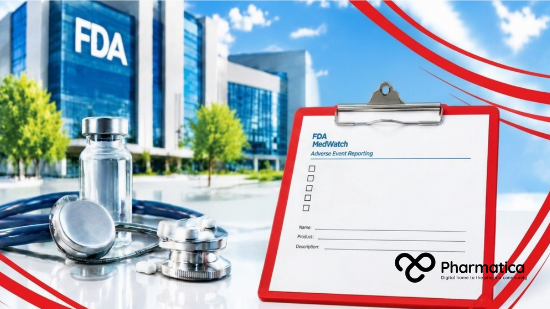
The FDA’s MedWatch supports drug and device safety through voluntary reports, mandatory industry submissions, and safety alerts. Explore its role in MedSafety Week 2026.
During MedSafety Week 2026, we examine how FDA’s MedWatch contributes to effective pharmacovigilance that depends on both accessible public reporting and robust industry surveillance in the U.S.
Image
MedWatch and Pharmacovigilance
The Food and Drug Administration’s MedWatch is a central part of the U.S. system for monitoring medicine and medical device safety after products reach the market.
Its voluntary reporting routes allow healthcare professionals and consumers to flag suspected problems, while manufacturers and other regulated organisations have separate mandatory reporting duties.
On the operational front, the key point is that Form 3500A remains the mandatory-reporting form, but it is not necessarily the end of the whole submission process.
Most manufacturer and importer medical device reports must be submitted electronically through the FDA’s electronic Medical Device Reporting (eMDR) system.
This distinction is important for Sponsors that still treat the paper form as the whole reporting process.
MedWatch Connects Public Reporting With Regulatory Surveillance
MedWatch is the FDA’s programme for receiving reports of serious problems involving human medical products.
It covers prescription and over-the-counter medicines, biologics, medical devices, combination products, cosmetics and certain cannabinoid hemp products.
The programme serves two connected purposes. It gives patients and healthcare professionals a route to report suspected problems, and it helps the FDA identify information that may require further investigation or regulatory action.
Reports can concern more than suspected adverse drug reactions. They can also identify:
Product quality defects, contamination, or suspected counterfeit products.
Medication errors and problems with product labelling or packaging.
Therapeutic failure or an unexpected lack of effect.
Medical device malfunctions and performance problems.
Other serious events that may be associated with a regulated medical product.
A suspected association is sufficient reason to report. A report does not establish that a medicine or device caused the event but it gives regulators information to assess alongside other reports, clinical evidence, and product-specific data.
For pharmacovigilance teams particularly, spontaneous reports do not constitute controlled clinical observations, and they do not establish incidence or causality on their own.
However, they can reveal patterns that were not apparent during clinical development or in earlier post-market monitoring.
Find out how Quality-by-Design improves reliability and compliance in pharma and how you can maximise innovation through quality-based pharma development systems.
FDA MedWatch Forms 3500, 3500B, and 3500A: Different Reporting Roles
The FDA uses three principal MedWatch forms. The choice of form depends on who is reporting and whether the report is voluntary or mandatory.
Form FDA 3500: Voluntary reporting by healthcare professionals
Form 3500 is designed primarily for healthcare professionals who identify a suspected adverse event, product problem, or medication error.
The form allows clinicians to provide relevant clinical details, including patient outcomes, medical history, treatment information, and suspected products.
It can support reports involving medicines, biologics, devices, and other products covered by MedWatch and healthcare professionals can submit reports through the online system or use the downloadable form.
The quality of the information reported is important. Product names, manufacturers, batch or lot numbers, treatment dates, and relevant clinical findings can help the FDA assess a report and identify possible patterns.
Form FDA 3500B: Voluntary reporting by patients and consumers
Form 3500B provides a more accessible reporting route for patients, consumers, and caregivers.
Its structure is designed for people who may not have access to clinical records or specialist medical terminology.
A patient can report a suspected reaction, a product defect, a medication error, or a problem with how a medicine or device performs.
The form helps capture the experience in a format that the FDA can evaluate.
This route is important because patients may notice problems that are not immediately reported through healthcare professionals. It also supports broader participation in post-market safety monitoring.
Image
Form FDA 3500A: Mandatory reporting
Form 3500A is the mandatory reporting form used by regulated organisations and specified reporting groups, including manufacturers, importers, user facilities, and certain Investigational New Drug (IND) researchers.
So, while Forms 3500 and 3500B support voluntary reporting, 3500A supports mandatory reporting obligations. The FDA also clarifies that 3500A should be used only where electronic submission is not required.
For sponsors and manufacturers, this means voluntary MedWatch reports should not be confused with the company’s own regulatory reporting duties. A manufacturer cannot rely on a healthcare professional or patient to submit a voluntary report in place of its required pharmacovigilance processes.
The FDA’s official form guidance sets out the different routes and their intended users.
Medical Device Reporting Adds Specific Industry Obligations
MDR establishes mandatory reporting requirements for manufacturers, importers, and device user facilities when specified device-related events occur.
The reporting thresholds and deadlines differ by organisation.
Reporting group
Main reporting obligation
FDA deadline
Manufacturers
Deaths, serious injuries and qualifying malfunctions
30 calendar days
Manufacturers
Certain events requiring urgent action or designated by FDA
Five work days
Importers
Deaths and serious injuries to FDA and manufacturer
30 calendar days
Importers
Qualifying malfunctions to the manufacturer
30 calendar days
Device user facilities
Suspected device-related deaths to FDA and manufacturer
10 work days
Device user facilities
Serious injuries to manufacturer, or FDA if manufacturer is unknown
10 work days
A manufacturer must report when it becomes aware that a device may have caused or contributed to a death or serious injury.
It must also report a malfunction if recurrence would be likely to cause or contribute to death or serious injury.
Hospitals and other qualifying user facilities have separate responsibilities. They must report suspected device-related deaths and serious injuries, but they are not subject to the same mandatory malfunction-reporting requirement as manufacturers. They can still submit voluntary reports about malfunctions through MedWatch.
Electronic reporting is now central to device surveillance
Since August 2015, applicable organisations have had to submit mandatory reports electronically in a format the FDA can process, review and archive.
The paper Form 3500A therefore does not represent the full operational requirement for most industry reporters. Companies need systems that can capture reportable events, assess them against regulatory criteria, prepare the required data, and submit reports electronically within the applicable deadlines.
The FDA’s eMDR guidance explains the electronic submission process, including follow-up reports and the need to retain submission acknowledgements.
For device manufacturers, the practical need is that complaint handling, quality management, post-market surveillance, and regulatory reporting need to work as connected processes
A complaint cannot be treated as a routine customer-service matter until the organisation has assessed whether it meets MDR reporting criteria.
The Looming Threat of Geopolitical Risk in Clinical Supply Chains
Geopolitical risk is reshaping how clinical supply chains are managed, demanding resilience and foresight. Learn why building supply chain resilience is the key for clinical trial success.
Image
FDA Early Alerts Strengthen Medical Device Safety Notifications
MedWatch is not only a reporting channel. It also helps distribute safety information to healthcare professionals, patients, consumers, and the wider industry.
The FDA provides safety information through its MedWatch emailed safety alerts and RSS feed.
These notifications cover clinically important information about medicines, biologics, devices, and other regulated products. Subscribers can receive updates relevant to the products they prescribe, dispense, use, or manufacture.
A particularly relevant development for device manufacturers is the expansion of the FDA’s Early Alert communications.
The Center for Devices and Radiological Health (CDRH) introduced an Early Alert pilot in November 2024. It aimed to shorten the time between the FDA becoming aware of a potentially high-risk device removal or correction and communicating that information publicly.
On 29 September 2025, the FDA expanded the programme to cover potentially high-risk removals and corrections involving all medical devices.
An Early Alert can communicate a company’s corrective action or removal before the FDA has determined whether the action meets the formal regulatory definition of a recall.
This creates an additional layer of visibility for the medical device sector. Companies should monitor not only formal recall notices, but also Early Alerts and safety communications that may require prompt action across distribution networks, healthcare facilities, and customer support operations.
The FDA provides dedicated medical device safety communications and recall and Early Alert listings. These should form part of a structured regulatory intelligence process, rather than being checked only after a product complaint arises.
Image
MedSafety Week 2026 Highlights the Value of Safety Reporting
MedSafety Week, running from 2 to 8 November 2026, places adverse reaction reporting in the public spotlight. Its theme, “Side effects – don't ignore them, report them”, reinforces the importance of communicating suspected problems through the appropriate national reporting systems.
The campaign is coordinated internationally, with the Uppsala Monitoring Centre supporting participation across countries.
For the industry, the campaign is a timely reminder that post-market safety depends on the quality and reach of reporting systems.
Voluntary reports can contribute to signal detection, while mandatory reporting ensures that organisations with specific regulatory responsibilities provide information within defined timeframes.
The distinction between the FDA’s three reporting forms is straightforward, but the operating model behind them is more demanding. Companies need clear processes for receiving reports, evaluating seriousness, identifying reportability, meeting deadlines, and following up with regulators.
Medical device manufacturers must also connect complaint management with eMDR submissions and monitor emerging safety communications.
MedWatch is only as useful as the information entering and moving through the system. A report that arrives late, lacks product identification, or remains isolated from other safety data can weaken the wider surveillance picture.
At Pharmatica, we examine how Regulatory Systems and pharmacovigilance and post-market intelligence shape patient safety and industry accountability. Understanding the reporting routes is part of maintaining confidence in medicines and medical technologies throughout their lifecycle.
Pharmatica: Insight. Connection. Impact.
Frequently Asked Questions
What is FDA MedWatch?
FDA MedWatch is the FDA’s safety information and adverse event reporting programme. It enables healthcare professionals and consumers to report suspected problems involving medicines, biologics, medical devices, and other FDA-regulated products. It also provides safety information and alerts to help people identify emerging risks.
What is the difference between FDA Forms 3500, 3500B, and 3500A?
The three forms serve different reporting purposes. Form 3500 is used voluntarily by healthcare professionals, while Form 3500B is designed for voluntary reporting by consumers and patients. Form 3500A is the mandatory reporting form for industry and other organisations with specific reporting obligations. However, manufacturers and importers generally submit medical device reports electronically through the FDA’s eMDR system where electronic reporting is required.
Are healthcare professionals required to report adverse events through MedWatch?
MedWatch provides a voluntary reporting route for healthcare professionals. A report can be submitted when a suspected adverse event, product quality problem, medication error, or other safety concern is identified. The reporter does not need to establish that the product caused the problem before reporting it. Separate reporting obligations may apply under other regulatory requirements or professional and organisational policies.
What medical device incidents must manufacturers report to the FDA?
Under the FDA’s Medical Device Reporting requirements in 21 CFR Part 803, manufacturers must report certain device-related deaths, serious injuries, and malfunctions. Deaths and serious injuries generally require reporting within 30 calendar days. Qualifying malfunctions also have a 30-day reporting deadline, while certain events identified by the FDA as requiring urgent attention must be reported within five work days.
How can pharmaceutical and medical device companies keep up with FDA safety notifications?
Companies should monitor FDA MedWatch safety alerts, medical device safety communications, Early Alerts, and recall announcements. They can also subscribe to FDA email updates and RSS feeds. These notifications should feed into established pharmacovigilance, medical device surveillance, quality management, and regulatory intelligence processes, rather than being treated as isolated communications.
Nicole (BSc Molecular Medicine, Honours Medical Biochemistry) has many years of pharmaceutical experience, having worked for top CROs and biopharma companies for more than a decade.
Did you enjoy the content?
2
Why not support
Nicole Dale
by giving this content a like
Seven Ways AI Is Solving Pharmaceutical Supply Chain Problems
AI is tackling the pharmaceutical supply chain's most persistent problems, from demand forecasting to counterfeit detection. See the top 7 ways AI is improving supply chain resiliency.
The Looming Threat of Geopolitical Risk in Clinical Supply Chains
Geopolitical risk is reshaping how clinical supply chains are managed, demanding resilience and foresight. Learn why building supply chain resilience is the key for clinical trial success.
Healthcare Supply Chains in Africa: Lessons from COVID-19
COVID-19 exposed major weaknesses in pharmaceutical supply chains. In this episode of Chain Reaction, Trisha Pillay and Émile Malan explore how AI, regulatory reform, and local manufacturing could strengthen healthcare resilience.
Regulatory leadership is no longer just compliance. In this episode of Chain Reaction, Dineshree Naiker explains why early regulatory strategy, supply chain governance, and value-based thinking are critical to improving patient access and healthcare outcomes.
Why Europe's Heatwave Is an Important Pharma Cold Chain Risk
Europe's 2026 heatwave is pushing pharmaceutical cold chain risk to the limit. Here is what supply chain leaders must do to protect drug integrity now.
Strait of Hormuz Closure Threatens Pharma Supply Chains
Closures around the Strait of Hormuz create growing pharma supply chain risks. Find out how energy, API, and freight shocks spread and how to build resilience.













Comments (0)