
Close the Drug Discovery Loop by Leveraging the DMTA Cycle

The DMTA cycle is the engine of modern pharma R&D. Learn how integrated DMTA workflows reduce early-stage attrition and compress drug discovery timelines.
Pipeline attrition is a massive headache in pharmaceutical R&D.
Less than 10% of compounds that enter Phase I trials ever make it to approval, and every failure carries a steep price tag. That's why drug discovery teams lean so heavily on the integrated DMTA cycle as their standard process for tightening up the drug discovery loop and cutting losses early.
What Is the DMTA Cycle in Drug Discovery?
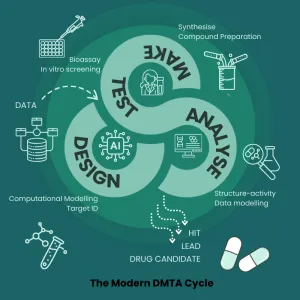
DMTA stands for design, make, test, and analyse, and it means you run a compound through these four stages then loop right back to redesign.
Unlike the traditional, linear, step-by-step process, DMTA is a closed circle: What you learn in one round goes straight into shaping the next set of hypotheses iteratively.
With each round, you focus in on the sweet spot and close in on compounds likelier to survive toxicology, pharmacokinetics, and efficacy hurdles.
Why the Drug Discovery Loop Can’t Be Linear
Running drug discovery in straight, isolated steps wastes both time and money. When chemistry, biology, and ADMET (absorption, distribution, metabolism, excretion, and toxicity) testing happen in disconnected handoffs, even one late-stage ADMET hiccup can wipe out a year's worth of chemistry work.
Well-run DMTA cycles mean that data gets back to design faster, and there are fewer wasted efforts on dead-end compounds.
Most DMTA-cycle time is spent on chemical iterations. The real leap forward comes when teams shrink cycle times from weeks down to days. Labs that digitalise DMTA workflows now get through each iteration in three to five days instead of several weeks.
How Should Pharma Companies Audit AI Vendors?
“This is one of the riskiest industries there is because you're dealing with human lives, you're dealing with experimental protocols, and you're dealing with regulatory bodies where you might not get another shot at that clinical trial."

The Four Stages of an Integrated DMTA Drug Discovery Workflow
The four stages of an integrated DMTA workflow are:
-
Design
Everything starts with translating biology into molecules. Tools like molecular docking, pharmacophore modelling, and now AI-powered design platforms produce ranked lists of candidate structures.
The quality of this stage makes or breaks the whole cycle. If the design is poor, all the hard work downstream is wasted.
This means you can’t just chase promising binding affinity. If a structure violates known metabolic stability rules, it’ll come back to bite you in the analysis stage, burning resources in the process.
No amount of automation can replace expert human judgement here. Chemists still need to call the shots on which series to pursue.
-
Make
Making covers synthesis, purification, and, crucially, quality control.
Parallel synthesis can speed this stage up. Where a skilled chemist might manually synthesise five to ten analogues per week, automated synthesis platforms can produce hundreds of structurally diverse compounds across the same period.
However, even with parallel synthesis, this stage is often a bottleneck, especially for complex molecules.
Assuring purity and checking structures is most critical at this stage, not throughput or producing more compounds. If you slip on this, compounds with undocumented impurities or incorrect structures introduce noise into the test, and the whole chemical series can get derailed.
Good Laboratory Practice (GLP) at this stage is therefore vital. Good lab practices aren’t something you can ignore and they’re essential if you don’t want to chase your tail later.
-
Test
This is where you put your compounds through rigorous evaluation to see if they would make good clinical candidates.
Good DMTA workflows start with fast, cheaper primary assays (like binding or cell viability screens), while only the promising drug candidates move on to more expensive secondary or in vivo assays.
Binding assays, for example, measure the affinity between a compound and its molecular target. A well-validated binding assay can screen hundreds of compounds per week at relatively low cost and will provide the first real quantitative signal that a molecule is binding the right target. Compounds that fail here do not proceed to expensive in vivo testing.
This tiered approach is fundamental to DMTA efficiency. Each gate should eliminate the majority of compounds before the next, more expensive, stage is reached.
-
Analyse
The analyse stage is where DMTA cycles either close the loop tightly or break down. Raw assay data must be transformed into actionable Structure-Activity Relationship (SAR) insights that directly inform the next design iteration.
That means you need strong data infrastructure and experienced medicinal chemists who know how to use and interpret it.
When results are stuck in different spreadsheets or spread across teams, design cycles slow to a crawl. Digital DMTA systems put all the data in one place, so chemists can actually work with a compound’s full profile.
Teams that really get this right usually save the most time at the point where data feeds design, making smarter, faster decisions because everything they need is right there.
AI in Pharma: Why the Future of Healthcare Starts With Patients, Not Tech
Kate O’Reilly, President & Chair of the Healthcare Businesswomen’s Association (HBA) Dublin-Ireland Chapter & Healthcare Transformation Partner at Roche, discusses AI in pharma, patient engagement, and the future of healthcare innovation.

Digitalising the Drug Discovery Workflow: Where the Real Gains Happen
The smartest investments in DMTA focus on addressing the most common pain points. Such investments may include:
- Electronic lab notebooks (ELNs) that store synthesis data in formats you can actually mine, not just copy into a database by hand.
- Platforms that link information, such as assay results, compound records, and SAR analytics, so chemists always have the complete picture.
- ADMET prediction tools built right into design, flagging problem compounds before anything gets synthesised.
UK agencies like the NHS Accelerated Access Collaborative and the Medicines Discovery Catapult have both pointed to data fragmentation as a key reason for wasted time.
Automation just for the sake of it isn’t the goal. The point is making sure no design decision gets made without the best, most complete data. When insight can flow straight from the lab bench to the chemist, the discovery loop finally works like it should.
Lead Optimisation: DMTA’s Heavy-Duty Action
Lead optimisation is where the DMTA cycle really earns its keep. Starting with a proven “hit” series, medicinal chemistry teams use successive DMTA iterations to fine-tune potency, selectivity, and ADMET, thereby weeding out anything with significant off-target effects.
The candidate that advances to formal preclinical development is the compound that has survived the most rigorous iterative scrutiny, not the most potent compound identified.
Focusing only on potency is a recipe for preclinical failure. Compounds with excellent in vitro binding affinity but poor aqueous solubility, high metabolic clearance, or toxic metabolites will fail in in vivo models regardless of their target engagement.
The DMTA cycle exists precisely to surface these trade-offs before they become incredibly expensive clinical failures.
The main optimisation strategies for lead compounds include those that are experimental, such as magnetic resonance and mass spectrometry, or those that are computational, including pharmacophore studies, molecular docking, molecular dynamics, and QSAR.
What Is an Integrated DMTA Workflow?
An integrated DMTA workflow connects the four DMTA stages into a single, continuously operating system rather than a series of handoffs between teams.
This means experimental data, compound information, and analytical outputs are shared in real time across chemistry, biology, data science, and manufacturing functions. Instead of waiting for results to move sequentially from one group to another, insights are immediately available to inform the next decision.
The result of integrated DMTA is reduced delays, limited data loss, and the assurance that each iteration is built on the most complete and current understanding of a compound series.
The result is a more responsive drug discovery loop, where decisions are made faster and with greater confidence, ultimately improving the efficiency of lead optimisation and reducing avoidable rework.

Practical Steps for R&D Teams
For heads of drug discovery and research, DMTA is more than theory. It’s a checklist you can actually use to improve the R&D and drug discovery process:
- Time each cycle: If you’re taking more than two weeks per loop, chances are your bottleneck is in making or analysing.
- Check your data flow: Can anyone on your team pull up the full SAR history for a compound series in under five minutes? If not, your infrastructure's holding you back.
- Review your gate criteria: Are primary assays genuinely eliminating the majority of compounds before secondary testing? If pass rates are above 40 per cent, gates are not selective enough.
- Bring ADMET to the front: Are predictive ADMET filters applied at the design stage, or only after synthesis? Late-stage ADMET filtering is the most avoidable source of wasted cycle iterations.
- Benchmark against industry data: Tufts CSDD publishes regular benchmarking data on preclinical development timelines. If your cycle times are at the industry average, there is room to improve.
Closing the Loop: From Process to Competitive Advantage
The DMTA cycle is no longer just a methodological framework. It is increasingly the operational backbone of modern drug discovery. As pipelines become more complex and attrition remains a persistent challenge, the ability to run faster, more integrated DMTA workflows is emerging as a key differentiator.
Organisations that successfully close the drug discovery loop are not simply iterating faster; they are making better decisions earlier, reducing downstream risk, and improving the overall efficiency of R&D and the drug discovery process.
In a landscape where timelines and capital efficiency are under constant pressure, this shift from fragmented workflows to fully integrated DMTA systems is becoming essential rather than optional.
At Pharmatica, we focus on the systems, strategies, and technologies shaping the future of pharmaceutical R&D, from foundational workflows like the DMTA cycle to next-generation approaches in AI-driven drug discovery. Our analysis is designed to help pharma industry leaders move beyond theory and identify where operational improvements translate into measurable impact.
Pharmatica: Insight. Connection. Impact.
Frequently Asked Questions
What does DMTA stand for in drug discovery?
DMTA stands for design, make, test, and analyse. It is the iterative four-stage workflow that medicinal chemistry teams use to progressively optimise a compound's potency, selectivity, and ADMET profile during lead optimisation.
How does the DMTA cycle reduce drug early-stage attrition?
The DMTA cycle reduces early-stage drug attrition by surfacing compound failures early and cheaply, before expensive in vivo or clinical testing. Each iteration eliminates weak candidates based on real assay data, so the compound advancing to preclinical development has survived the most rigorous multiparameter scrutiny.
What is an integrated DMTA workflow?
An integrated DMTA workflow connects the design, make, test, and analyse stages into a unified system where data flows continuously between teams. Instead of operating in silos, chemistry, biology, and data science functions share real-time insights, enabling faster and more informed decision-making throughout the drug discovery loop.
What is the difference between integrated DMTA and a traditional discovery pipeline?
A traditional discovery pipeline moves compounds through chemistry, biology, and toxicology in sequential handoffs, often with significant delays between stages. Integrated DMTA treats the four stages as a single connected workflow, with data flowing continuously from the bench back into the design stage, compressing iteration time from weeks to days.
How long does a single DMTA cycle take?
Cycle times vary significantly by organisation and therapeutic area. The industry average is several weeks per iteration. Programmes with digitalised workflows and automated synthesis platforms have compressed this to three to five days. Lead optimisation programmes typically require 50 to 200 DMTA iterations before a candidate is nominated.
What role does medicinal chemistry play in the DMTA cycle?
Medicinal chemistry is central to both the design and analyse stages of the DMTA cycle.
Computational tools can propose candidate structures and flag predicted liabilities, but experienced medicinal chemists provide the multiparameter judgement required to prioritise chemical series, interpret SAR data, and navigate trade-offs between potency, selectivity, and pharmacokinetic properties.
About the author
Did you enjoy the content?
Why not support Nicole Dale by giving this content a like












Comments (0)