Ocular drug delivery faces major biological barriers. Nanocarriers could improve bioavailability, tissue targeting, controlled release, and treatment for difficult eye diseases.
Ocular drug delivery remains one of the most difficult problems in pharmaceutical development. Nanomaterials could help overcome the eye’s biological barriers, improve drug exposure, and create more effective treatments for diseases that threaten vision.
Image
An Unusually Difficult Drug Target Built to Keep Things Out
The World Health Organization estimates that at least 2.2 billion people globally have near or distance vision impairment, with at least 1 billion cases preventable or yet to be addressed.
The need for better treatments is substantial.
Age-related macular degeneration, glaucoma, and diabetic retinopathy are among the major causes of vision loss.
Yet developing effective medicines for the eye presents a distinctive pharmaceutical challenge.
The eye is designed to keep foreign substances out with its protective biological barriers.
Tears dilute and remove topical medicines and blinking and nasolacrimal drainage shorten residence time. The cornea restricts penetration, while deeper structures are protected by additional barriers, including the blood-retinal barrier.
These defences are essential for protecting the eye, but they also make it difficult to deliver therapeutic concentrations to diseased tissue.
This creates a fundamental problem for drug discovery.
Finding an active molecule is only part of the challenge. Getting enough of it to the right ocular tissue is another.
For posterior eye conditions, such as age-related macular degeneration (AMD), diabetic retinopathy, and glaucoma, the problem becomes even harder. Conventional topical treatments often struggle to reach the retina and other deeper tissues, while intravitreal injections can require repeated administration.
A molecule can work biologically and still fail as a medicine because it cannot reach the right ocular tissue at the right concentration for long enough.
Why Conventional Drug Delivery Often Falls Short in Ocular Disease
Eye drops remain one of the simplest ways to administer medicine, but they’re also limited by the eye’s own defence mechanisms and are poorly suited to many delivery challenges.
Rapid clearance can reduce drug exposure, while poor penetration can prevent sufficient concentrations from reaching diseased tissue.
Additionally, frequent dosing can then become necessary, increasing the burden on patients and potentially affecting adherence.
These limitations are central reasons for pursuing new delivery technologies.
Posterior-segment diseases represent an even greater challenge. Treating the retina often requires medicines to cross several barriers or be delivered directly into the eye.
Intravitreal injection could solve part of the penetration problem by placing treatment directly into the vitreous. But this is invasive and can require repeated procedures for chronic retinal diseases.
Other conventional ocular administration routes include topical delivery, conjunctival and scleral administration, intracameral administration, retrobulbar injection, and systemic administration.
Each route offers advantages, but each also faces limitations created by ocular anatomy and pharmacokinetics.
Topical medicines face particularly rapid clearance, with bioavailability of conventional ocular therapeutics typically below five per cent, highlighting how little of an administered dose may reach the relevant tissue.
This creates a difficult trade-off between therapeutic exposure, patient burden, safety, and dosing frequency.
Reimagine AI-driven Drug Discovery with Pharma Superintelligence
Explore how AI-driven drug discovery is evolving through Pharmaceutical Superintelligence and what your organisation can do to keep up.
Nanocarriers Could Improve Ocular Drug Delivery
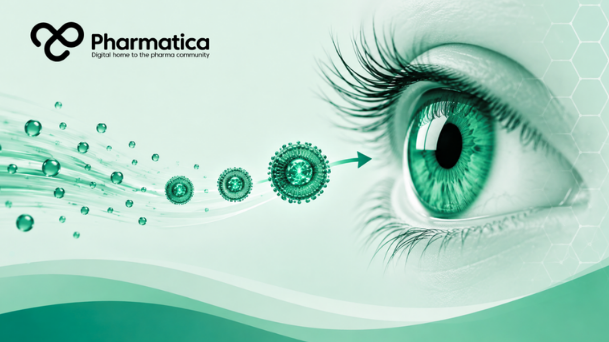
Nanotechnology offers a different approach for ocular drug delivery.
Instead of asking only which molecule should treat a disease, researchers can also design the system that carries that molecule to its target and nanomaterials can be engineered to interact differently with the eye.
Their small size, surface properties, composition, and stability can be adjusted to influence where medicines travel and how long they remain available.
Nanocarriers can also protect therapeutic compounds from degradation and provide controlled release.
There are a broad range of emerging ocular drug delivery systems, including nanomicelles, nanoparticles, nanosuspensions, nanoemulsions, microemulsions, dendrimers, liposomes, niosomes, nanofibres, nanowafers, microneedles, and exosomes.
The approaches span several material classes, including:
Polymer-based nanomaterials for controlled and targeted delivery
Lipid and composite systems designed to improve drug stability and penetration
Metal and metal-oxide nanomaterials with potential therapeutic and diagnostic functions
Carbon-based materials being investigated for specialised ophthalmic applications
These platforms can be engineered for different delivery objectives.
Nanoparticles can support sustained release, improve absorption, and protect drugs from premature degradation.
Nanomicelles can improve the solubility and delivery of poorly water-soluble compounds.
Liposomes and niosomes can encapsulate therapeutic molecules and alter their distribution.
Nanofibres, nanowafers, and microneedles offer alternative ways to increase residence time or bypass specific ocular barriers.
Exosomes and related biological systems offer potential routes for delivering complex biological cargo.
The point is not that one nanocarrier will solve ocular drug delivery. It is that the platform can be matched to the specific biological and pharmacological problem.
Recently there’s been an important shift towards materials that do more than transport an active ingredient. Some nanomaterials have intrinsic antioxidant, antibacterial, or anti-inflammatory properties, potentially combining delivery and therapeutic activity within the same platform.
For retinal diseases such as AMD and diabetic retinopathy, researchers are investigating how modifying nanomaterial properties can improve targeting and sustain drug release at the disease site.
Image
Small Engineering Changes Can Have Large Ocular Drug Delivery Effects
Nanocarrier performance depends on more than particle size.
Physicochemical properties including surface charge, hydrophobicity, viscosity, osmolarity, biodegradability, drug loading, and release behaviour are all important determinants of performance.
This makes formulation science increasingly connected to therapeutic design.
For example, the ocular surface carries a negative charge, meaning positively charged nanoparticles can have greater surface retention than negatively charged particles.
Nanocarriers can also be designed to protect active ingredients, improve intracellular penetration, and release their payload over an extended period.
This opens up whether a delivery platform can rescue a promising therapeutic that conventional administration cannot deliver effectively?
That question becomes particularly relevant for biologics, nucleic acids, and other molecules whose size, stability, or physicochemical properties make conventional ocular delivery difficult.
Translation Remains the Real Test for Ocular Drug Delivery Effectiveness
While the technology is advancing, clinical translation remains difficult.
However, some nanotechnology-based ophthalmic products are already on the market or in clinical trials, alongside recent patents, demonstrating that some approaches have progressed beyond early laboratory research.
But the majority of novel systems remain at the very early research stage.
Drug developers must establish that a nanocarrier is safe for sensitive ocular tissues, remains stable, releases its payload predictably, and can be manufactured consistently.
The therapeutic system must also demonstrate meaningful benefit in relevant biological models before clinical development can justify its cost and risk.
The regulatory bar adds another layer.
The U.S. Food and Drug Administration (FDA) guidance on topical ophthalmic products highlights microbiological quality, particulate matter, impurities, stability, container-closure systems, and drug-release testing as important quality considerations.
That means nanocarrier design cannot be separated from manufacturability and product quality.
In summary, nanomaterial-based ocular medicines are still far from ready for widespread clinical use.
Biocompatibility, long-term safety, targeted delivery, scalable manufacturing, and translation from preclinical models remain major hurdles.
Additionally, the eye is particularly sensitive to foreign materials, making safety assessment critical.
This is where the drug discovery process matters most.
The wider drug discovery challenge is familiar. Strong preclinical activity does not guarantee clinical success. Pharmatica's analysis of preclinical drug development explores the wider challenge of generating evidence that translates effectively into human medicine.
Advanced ocular delivery fits into that same shift. Developers need evidence that a formulation can reproduce the required exposure in the relevant human tissue, not simply that a molecule performs well in a laboratory assay.
While a nanocarrier can improve laboratory measurements without necessarily producing a better medicine, developers still need evidence that the system behaves predictably in relevant biological environments and can be manufactured consistently.
Find out how Quality-by-Design improves reliability and compliance in pharma and how you can maximise innovation through quality-based pharma development systems.
Image
Ocular Drug Delivery Is a Discovery Strategy
Innovative ocular drug delivery and formulation science could determine which therapeutic concepts become viable medicines.
A molecule with strong activity may fail because it cannot reach its target. On the other hand, a less conventional therapy could become viable if a delivery system improves penetration, residence time, targeting, or tolerability.
That makes nanocarriers increasingly relevant to the Drug Discovery Loop, particularly as pharma explores complex biological targets and therapies that require precise tissue targetting.
Target biology, molecular design, formulation, tissue exposure, and patient usability increasingly need to be considered together.
Pharmatica’s analysis of clinical trial success shows how high attrition remains across drug development. Improving delivery at the discovery stage could therefore have big benefits.
Going Bigger than the Nanoparticle for Ocular Drug Delivery
There is a more clear future in which ocular drug delivery becomes more targeted, sustained, non-invasive, and adaptable to different therapeutic payloads. Besides nanoparticles, gene therapy, exosomes, and self-nanoemulsifying systems are all areas with substantial potential.
But nanotechnology is not a shortcut around clinical development. Long-term safety, reproducibility, scalable manufacturing, pharmacokinetics, and human efficacy will determine which platforms survive.
Pharmatica’s analysis of modern drug discovery examines why overcoming development bottlenecks increasingly requires integrating biology, technology, and translational science.
Nanomaterials can address several fundamental weaknesses in ocular drug delivery, but clinical translation will depend on proving that these advantages survive the journey from laboratory design to scalable, safe, effective medicines.
As a result, the next generation of ocular medicines may therefore depend as much on how a therapy reaches the eye as on what the therapy does once it arrives.
Pharmatica tracks the technologies reshaping Therapeutic Drug Discovery, from advanced delivery systems to new approaches for solving the biological and translational barriers that limit R&D success. Our Insights focus on where scientific innovation can create measurable value.
Pharmatica: Insight. Connection. Impact.
Image
Frequently Asked Questions
Why is ocular drug delivery so difficult?
Ocular drug delivery is difficult because the eye has multiple static and dynamic biological barriers that protect its tissues from foreign substances. Tear turnover, blinking, nasolacrimal drainage, the cornea, sclera, vitreous, blood-aqueous barrier, and blood-retinal barrier can all limit how much medicine reaches its intended target.
How much of an eye drop reaches the eye?
Conventional topical medicines have very low ocular bioavailability, typically below 5%, according to the Springer review. Rapid tear turnover and drainage can remove medicines from the ocular surface within minutes, while the cornea and other tissues further restrict penetration.
How can nanocarriers improve ocular drug delivery?
Nanocarriers can be engineered to improve drug retention, permeability, stability, targeting, and controlled release. Depending on their design, they may help therapeutic molecules cross ocular barriers, remain at the target site for longer, and reduce the need for frequent dosing.
Which nanocarriers are being investigated for eye diseases?
Research covers a broad range of systems, including nanoparticles, nanomicelles, nanosuspensions, nanoemulsions, dendrimers, liposomes, niosomes, nanofibres, nanowafers, microneedles, and exosomes. Different platforms can address different challenges, from drug solubility and stability to tissue targeting and sustained release.
Can nanocarriers replace injections for retinal diseases?
Nanocarriers could potentially reduce reliance on invasive administration for some applications, but they are not yet a universal replacement for intravitreal injection. Posterior-segment diseases remain particularly difficult because the blood-retinal barrier and other ocular structures restrict access to the retina. The review identifies non-invasive and minimally invasive delivery as important areas for future research.
Nicole (BSc Molecular Medicine, Honours Medical Biochemistry) has many years of pharmaceutical experience, having worked for top CROs and biopharma companies for more than a decade.
Did you enjoy the content?
1
Why not support
Nicole Dale
by giving this content a like
What 13 Years of Data Shows About Drug Innovation in Psychiatry
From 2012 through 2024, the FDA only approved 22 drugs for the treatment of psychiatric conditions. Pharma R&D teams must rethink development strategies to unstall drug innovation in psychiatry
Pharmacoinformatics is redefining drug discovery strategy. This analysis covers the AI platforms, molecular design tools, and regulatory frameworks shaping R&D pipelines in 2026.
Why Precision Alone Isn't Enough in Oncology Drug Discovery
Precision alone isn’t enough in oncology drug discovery. See why execution, biomarkers, and trial design determine scalable success in precision medicine.
Phenotypic drug discovery is reshaping how pharma finds first-in-class drugs. This analysis covers the methods, AI integration, and strategic decisions R&D leaders face in 2026.
Learn how drug discovery scientists are evolving alongside AI, computational biology, and multidisciplinary research to accelerate therapeutic innovation.










Comments (0)