Explore how personal health AI agents combine wearable data, medical knowledge, and behavioural coaching to deliver more personalised, continuous health support.
Personal health AI is moving towards a model that combines wearable data, medical information, clinical knowledge, and behavioural coaching within a single intelligent system.
Building multi-agent architectures that can interpret individual health information and deliver personalised support is challenging. However, understanding how these systems work is increasingly important as AI agents are used in digital health, patient engagement, and the relationship between healthcare providers and patients.
Image
How Do Personal Health AI Agents Work?
Personal health AI agents are designed to do more than just answer general health questions.
They can combine several capabilities to interpret information about an individual, identify health patterns, explain possible significance, and help users make sense of their health over time.
A conventional chatbot typically responds to a prompt using its underlying language model and the information supplied in the conversation. An AI agent can take a more active approach. It may break a request into smaller tasks, retrieve relevant information, analyse data using external tools, assess the results, and combine its findings into a response.
That could be very important in healthcare. A question such as “Why has my resting heart rate increased over the past month?” requires more than a general explanation of resting heart rate.
A more useful response would need to examine the user’s measurements over time, consider relevant changes in activity or sleep, and explain what the available information can and cannot establish, and if, needed, assess if there may be underlying disease and provide information in a sensitive manner that allows the user to connect with proper healthcare professionals to assess properly.
Personal health AI agents aim to bring these capabilities together. Depending on their design and permissions, they may work with information from:
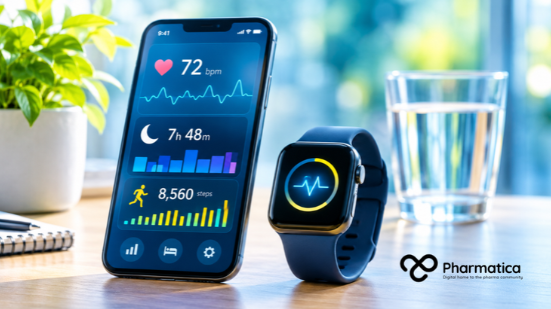
Wearables and connected health devices, including heart rate, sleep, activity and exercise measurements.
Personal medical information, such as laboratory results, medication lists and relevant medical history.
User-provided information about symptoms, lifestyle, wellbeing and health goals.
Clinical knowledge and trusted medical literature.
Population-level datasets that help place individual measurements into context.
The quality of the resulting insight depends on the accuracy, completeness and relevance of these inputs.
An agent cannot reliably interpret information it does not have, and a sophisticated architecture does not automatically make its conclusions clinically correct.
Why Do Personal Health AI Agents Need Multiple Specialised Capabilities?
Personal health questions cover several different types of reasoning. Some require numerical analysis, others need medical knowledge, while many involve behaviour, motivation, and communication.
A single AI model may be able to perform all these tasks to varying degrees, but combining them reliably is difficult.
An agent that is good at explaining medical concepts may not be equally dependable when calculating trends across months of wearable data. Similarly, an agent that can identify a numerical pattern may not be equipped to translate that finding into appropriate behavioural guidance.
Multi-agent architectures address this challenge by assigning different responsibilities to specialised agents.
Rather than expecting one system to perform every task in the same way, developers can create a coordinated group of agents, each with a defined role.
A typical personal health AI architecture may include three core capabilities.
1. Data analysis and interpretation
A data-focused agent works with numerical and longitudinal information. It can examine trends, compare measurements across different periods, identify changes, and perform calculations that would be difficult to complete through a conventional conversational exchange.
For example, a user might ask whether their physical activity has improved over the past three months. The agent could examine daily step counts, exercise sessions, and other available measurements, calculate changes over time, and identify relevant patterns.
This requires more than retrieving a number. The agent must understand the question, identify which data points are relevant, account for missing information, and select appropriate calculations. Where necessary, it may use code execution or analytical tools rather than relying entirely on language-model reasoning.
Population-level information can add another layer of context. An individual measurement may appear unusual in isolation but have a different interpretation when considered alongside appropriate reference data. However, population averages should not be treated as personalised clinical thresholds if not inside recommended health guidelines.
2. Health knowledge and contextual reasoning
A health domain agent interprets information using medical and scientific knowledge. Its role is to connect personal measurements with relevant context, explain terminology, and distinguish between established evidence and possible explanations.
For example, a user reviewing a blood test result may want to understand what a particular biomarker measures and why it matters. An agent could explain the biomarker, consider the reference range supplied with the result and identify relevant questions for discussion with a healthcare professional.
More advanced systems can use retrieval tools to consult trusted medical sources, research databases, and other approved information repositories. This can help ground responses in identifiable evidence rather than relying solely on information encoded in the underlying model.
Nevertheless, interpreting a laboratory result requires more than comparing a number with a reference range. Age, medical history, medication, symptoms, laboratory methods, and other clinical factors may influence its significance.
Personal health AI should therefore communicate uncertainty and avoid presenting incomplete information as a diagnosis.
3. Behavioural coaching and ongoing support
A coaching agent focuses on the interaction between health information and individual behaviour.
It can help users establish goals, consider barriers, monitor progress, and maintain a conversation about changes over time.
For example, someone seeking to improve sleep may benefit from tracking sleep patterns, discussing lifestyle factors, and setting realistic behavioural goals.
An agent could review progress during subsequent conversations and adapt its suggestions as the user provides more information.
This function is different from simply generating a list of wellness recommendations. Effective coaching requires continuity, appropriate communication, and an understanding of the user’s stated objectives.
Some systems may incorporate behavioural techniques, such as motivational interviewing, to encourage reflection and support goal-setting.
The coaching function also introduces important boundaries. AI-generated encouragement should not become pressure, and an agent must recognise when a user’s concerns require professional assessment rather than further lifestyle advice.
How AI Is Opening New Opportunities in Fertility Care for Pharma
"If I had to get great minds in a room, I'd be looking at it from a tech perspective. How can we take all this knowledge, apply it to policies that can be easily distributed?” Clara Toombs, Fertilia AI.
Image
How Do Multi-Agent Systems Work Together?
Specialisation alone is not enough. The agents need to exchange information, coordinate their tasks, and produce a coherent response.
This is where an orchestrator becomes important. It acts as the coordination layer, interpreting the user’s request and deciding which agents or tools should contribute.
It can assign tasks, collect results, identify gaps, and combine the outputs into a single response.
A typical workflow may look like this:
Understand the request: The system identifies whether the user needs data analysis, health information, behavioural support, or a combination of these.
Assign specialist tasks: The orchestrator directs relevant parts of the request to the appropriate agents.
Gather and analyse information: Agents examine available personal data, consult approved sources or use analytical tools.
Review the findings: The system checks whether the information is sufficient and whether additional investigation is needed.
Generate a response: The orchestrator combines the results into an explanation or set of recommendations, ideally making limitations and uncertainty clear.
Continue the interaction: Where supported, the system can retain relevant context and use subsequent conversations to monitor progress or address new questions.
This approach can make personal health AI more flexible than a fixed chatbot. A straightforward question may require only one specialist capability, while a more complex request may involve several agents working together.
However, coordination introduces its own risks. Errors made by one agent can influence the work of another. Conflicting outputs, incorrect assumptions, or poor orchestration can produce a response that appears consistent but is based on flawed reasoning.
Developers therefore need mechanisms to check information, manage uncertainty, and maintain appropriate oversight.
Image
What Does Research Reveal About Personal Health AI Agents?
A useful example of this approach is the personal health agent described in a 2026 Nature study, The Anatomy of a Personal Health Agent.
The researchers developed an open-source, multi-agent framework that combines data analysis, health-domain reasoning, and behavioural coaching.
Its orchestrator coordinates the specialist agents to support four broad user journeys: General health knowledge, personal data interpretation, wellness advice and symptom assessment.
The study illustrates how these roles can operate together.
Its data science agent analyses longitudinal wearable and medical data, including population-level statistics. The health domain expert agent combines personal information with health knowledge to generate contextualised insights and the health coach agent supports multi-turn conversations, goal-setting, and progress tracking.
The researchers evaluated the specialist agents and integrated agents across 11 benchmark tasks. The evaluation involved more than 7,000 annotations and 1,350 hours of work from health experts and end users.
The authors reported that the integrated architecture performed better than the single-agent and parallel multi-agent comparison systems in their evaluations.
These findings provide evidence of the potential of coordinated specialist agents, but they do not establish improved clinical outcomes or demonstrate effectiveness in routine healthcare delivery.
The study also highlights the importance of system boundaries. Its medical-record inputs were limited to blood test results because of data-access constraints, and the authors identified broader electronic health record integration as an area for future development.
But, importantly, the framework was not designed to replace healthcare providers.
Importantly, the researchers made the core implementation available as an open-source, model-agnostic framework.
Although the main experiments used the Gemini 2.0 model family, the architecture was designed to work with other capable language models, making the work relevant beyond one particular AI platform. Explore the open-source AI information for the personal health agent.
Find out how Quality-by-Design improves reliability and compliance in pharma and how you can maximise innovation through quality-based pharma development systems.
Image
What Could Personal Health AI Mean for Pharma?
The development of more capable health agents has importance for far more than consumer wellness applications.
Sponsors are increasingly expected to consider the patient experience across the treatment journey, including diagnosis, treatment initiation, adherence, monitoring, and long-term support.
Personal health AI could contribute to this shift in several ways.
More personalised patient engagement
Digital patient support programmes often rely on scheduled communications, educational materials, and standardised reminders.
AI agents could make these interactions more responsive by considering a patient’s stated needs, preferences, and relevant health information.
For example, a patient receiving a long-term treatment might use an approved digital support tool to access information about treatment routines, prepare questions for appointments, or track self-reported experiences. The system could tailor educational content to the patient’s level of understanding and direct them to appropriate support when concerns arise.
This would not remove the need for human contact. Instead, it could help make patient support more accessible between clinical interactions, provided the system operates within clearly defined boundaries.
New opportunities for real-world evidence
Wearables and connected health devices generate longitudinal information that may complement traditional clinical data.
With appropriate consent, governance, and methodological controls, these sources could help researchers understand patterns in activity, sleep, symptoms, and other patient-reported or physiological measures.
AI agents may help organise and interpret real-world data, making it easier to identify patterns for further investigation.
However, data collected through consumer devices is not automatically suitable for clinical research. Differences in device accuracy, missing measurements, population representation, and user behaviour all affect the reliability of the evidence.
More connected treatment support
Personal health AI could eventually support services that connect patients, healthcare professionals, and pharmaceutical support programmes.
A system might help users understand educational materials, track agreed treatment-related goals, and prepare information for consultations.
For pharma, this creates opportunities to rethink digital patient services as more continuous experiences rather than isolated interventions.
But, it also raises questions about who controls the data, how information is shared, and where responsibility sits when an AI-generated response influences a health-related decision.
Image
What Are the Main Risks and Regulatory Challenges?
The potential of personal health AI depends on trust.
Health information is sensitive, and an inaccurate or misleading response can have consequences beyond a poor digital experience.
Clinical safety and oversight are therefore central concerns. Systems must distinguish between general health education and advice that could influence diagnosis or treatment.
Systems should communicate uncertainty, avoid unsupported conclusions, and recognise when a user needs professional care. Developers also need to evaluate performance across different populations, health conditions, and real-world scenarios.
Privacy and data governance are equally important. Combining wearable measurements, medical records, and personal conversations creates a detailed picture of an individual’s health.
Organisations must establish clear rules for consent, access, retention, security, and secondary use. Users should understand what information is being collected and how it may be used.
Regulatory classification will depend on intended purpose and functionality, not simply whether a product uses AI agents.
The US Food and Drug Administration’s January 2026 Clinical Decision Support Software Guidance clarifies the criteria for certain software functions to qualify as non-device clinical decision support.
The FDA’s guidance also confirms that existing digital health policies continue to apply to software functions that meet the definition of a medical device, including relevant patient- and caregiver-facing functions.
Interoperability presents another practical challenge.
Personal health information is distributed across devices, healthcare providers, laboratories, and digital platforms. Without reliable ways to exchange and standardise this information, agents may work with incomplete or inconsistent records.
The ability to connect data sources safely will be as important as the sophistication of the underlying AI.
Could Personal Health AI Agents Become Part of Everyday Healthcare?
Personal health AI agents may present a way to a more connected model of digital health, in which information is interpreted continuously rather than accessed only when a user submits a question.
Multi-agent architectures offer one way to combine numerical analysis, health knowledge, and behavioural support while maintaining a more coherent interaction.
The technology remains quite new and research demonstrations and user evaluations are not substitutes for clinical validation, regulatory assessment, or evidence of improved patient outcomes.
Real-world deployment will require robust safeguards, transparent data practices, reliable integrations, and clear accountability.
The opportunity lies in understanding how these systems could complement patient services, support more informed engagement, and generate new questions about the use of longitudinal health information.
The next phase will depend not simply on building more capable agents, but on demonstrating that they can provide safe, useful, and trustworthy support.
At Pharmatica, we examine the Technologies shaping life sciences and the strategic decisions they create for pharmaceutical leaders, healthcare innovators, and the wider industry.
Pharmatica: Insight. Connection. Impact.
Frequently Asked Questions
What is a personal health AI agent?
A personal health AI agent is an AI-powered system designed to interpret individual health information and respond to questions or support needs. Depending on its capabilities, it may analyse wearable measurements, explain medical information, provide general wellness guidance, and support ongoing health goals.
How is an AI health agent different from a chatbot?
A conventional chatbot primarily responds to user prompts. An AI agent can also plan tasks, use external tools, analyse information, retrieve evidence, and coordinate specialised capabilities. Multi-agent systems divide these responsibilities between different agents and combine their outputs.
Can personal health AI agents analyse wearable data?
Some systems can analyse longitudinal information from compatible wearables, including activity, sleep, and heart rate measurements. They may identify trends and compare measurements over time. The usefulness of the analysis depends on data quality, device accuracy, and the system’s ability to interpret the information appropriately.
Can personal health AI replace doctors?
No. Personal health AI may help people understand health information and prepare for discussions with healthcare professionals, but it should not be treated as a replacement for medical assessment, diagnosis, or treatment decisions. Research frameworks in this area are not evidence that AI agents can safely assume those responsibilities.
How could personal health AI benefit pharma?
Potential applications include more personalised patient engagement, digital treatment support, and the analysis of consented real-world health information. These opportunities depend on appropriate clinical oversight, privacy protections, regulatory compliance, and evidence that the systems provide meaningful benefits.
Nicole (BSc Molecular Medicine, Honours Medical Biochemistry) has many years of pharmaceutical experience, having worked for top CROs and biopharma companies for more than a decade.
Did you enjoy the content?
1
Why not support
Nicole Dale
by giving this content a like
Seven Ways AI Is Solving Pharmaceutical Supply Chain Problems
AI is tackling the pharmaceutical supply chain's most persistent problems, from demand forecasting to counterfeit detection. See the top 7 ways AI is improving supply chain resiliency.
The Looming Threat of Geopolitical Risk in Clinical Supply Chains
Geopolitical risk is reshaping how clinical supply chains are managed, demanding resilience and foresight. Learn why building supply chain resilience is the key for clinical trial success.
Healthcare Supply Chains in Africa: Lessons from COVID-19
COVID-19 exposed major weaknesses in pharmaceutical supply chains. In this episode of Chain Reaction, Trisha Pillay and Émile Malan explore how AI, regulatory reform, and local manufacturing could strengthen healthcare resilience.
Regulatory leadership is no longer just compliance. In this episode of Chain Reaction, Dineshree Naiker explains why early regulatory strategy, supply chain governance, and value-based thinking are critical to improving patient access and healthcare outcomes.
Why Europe's Heatwave Is an Important Pharma Cold Chain Risk
Europe's 2026 heatwave is pushing pharmaceutical cold chain risk to the limit. Here is what supply chain leaders must do to protect drug integrity now.
Strait of Hormuz Closure Threatens Pharma Supply Chains
Closures around the Strait of Hormuz create growing pharma supply chain risks. Find out how energy, API, and freight shocks spread and how to build resilience.












Comments (0)