Europe's 2026 heatwave is pushing pharmaceutical cold chain risk to the limit. Here is what supply chain leaders must do to protect drug integrity now.
As temperatures across Europe shatter records in June 2026, the pharmaceutical cold chain risk gives impetus to develop and implement major contingency plans to make sure the supply of key medicines is not affected.
With France recording its hottest day since meteorological measurements began and the UK approaching 38 degrees Celsius, the integrity of temperature-sensitive medicines across Europe is under acute, real-time pressure.
For the pharma supply chain, this is not a weather event to just observe from a distance.
The heatwave poses an extreme stress test with direct consequences for patient safety, regulatory compliance, and financial exposure.
Image
A Planet Under Heat Stress
The scale of the current conditions across Europe is genuinely concerning, even scary.
A powerful heat dome, driven by a stagnant Saharan air mass trapped beneath a high-pressure ‘omega block’, has settled across Western Europe since late May 2026.
By 22 June, France placed 54 of its 96 mainland departments under a red alert, recording a peak of 44.3 degrees Celsius in the southwest. Portugal and Spain approached 45 degrees Celsius across multiple regions. Austria logged 36.6 degrees Celsius at GeoSphere stations.
The conditions are not just extremely uncomfortable.
Meteorologists described the current pattern as a heat-dome driven furnace, with temperatures running 14 to 18 degrees Celsius above seasonal averages across much of the continent.
Climate scientists note that Europe is warming at roughly twice the global average, meaning events of this nature are becoming features of the European summer calendar.
The direct infrastructure consequence that matters most for pharmaceutical supply chains in these extreme conditions is power supply.
Electricity demand across France and Spain has surged as cooling systems operate at capacity, and grid operators have warned of blackout risks. Turin reported repeated underground cable failures triggered by heat-stressed infrastructure. In Brittany, thousands of homes lost power mid-heatwave.
For any pharma facility or transit node relying on active refrigeration equipment, a power interruption is more than an inconvenience. It might even create a regulatory and patient safety incident.
Image
What Temperature Excursions Actually Cost Pharma
The financial and clinical stakes of cold chain failure are substantial and well-documented.
The FDA estimates that the pharmaceutical industry loses approximately 35 billion US dollars annually as a direct consequence of cold chain failures.
Most refrigerated medicines require storage between two and eight degrees Celsius. A deviation of even one or two degrees can degrade biologics, vaccines, and insulin to the point of clinical ineffectiveness or patient harm.
The problem is growing as the product mix shifts. By 2018, almost half of all FDA-approved medicines were temperature-sensitive.
The prevalence of temperature-sensitive medicines is expected to grow steadily through 2030, driven by the expansion of biologics and cell and gene therapies.
Each new entrant to this category raises the individual price of an excursion event, both financially and clinically.
The chemistry underlying heat-induced degradation follows a well-established pattern.
For every ten-degree Celsius rise in temperature, the rate of oxidation and hydrolysis in stored medicines increases exponentially.
During a British heatwave in 2003, it was found that drug storage environments in primary care settings and vehicles routinely exceeded 25 degrees Celsius on every single day of the study period, with temperatures in car boots reaching nearly 50 degrees Celsius under direct sun.
Most pharmaceutical licences specify a maximum storage temperature of 25 degrees Celsius, meaning the vast majority of ambient storage environments across Europe are currently non-compliant by a significant margin.
The consequences of extreme heat extend beyond immediate spoilage.
Even where a product is not rendered unsafe, heat exposure can reduce its shelf life, alter its dissolution profile, or compromise bioavailability in ways that are not visually detectable but are clinically meaningful.
For high-value biologics and injectable therapies, these invisible degradation effects carry significant liability implications.
How AI Is Reshaping Data Integrity in Pharma Manufacturing
Veragence CEO Nour AlSaleh discusses how AI is transforming data integrity in pharma manufacturing, regulatory compliance, the "human-in-the-loop" requirement, and patient safety in the era of AI-driven GxP systems.
Image
Active Versus Passive Pharma Cold Chain Systems: Where the Vulnerability Lives
The current European conditions expose an important vulnerability in pharmaceutical logistics infrastructure that has grown as the medicines product portfolio has shifted.
Active refrigeration systems, whether fixed cold rooms, refrigerated vehicles, or powered containers, maintain temperature through continuous electrical operation.
Therefore, they are effective under normal conditions but carry an intrinsic dependency on power supply that becomes a liability when power grids fail.
There is a substantial blackout risk facing multiple European countries as air conditioning demand drives electricity consumption to peak levels simultaneously.
Energy providers in France and Spain have already urged industrial consumers to reduce consumption during peak afternoon hours.
For pharmaceutical warehouses and distribution centres in affected regions, this creates a scenario where the very conditions that elevate temperature risk also threaten the power systems on which active temperature control depends.
Passive pharma cold chain systems using phase change materials offer a fundamentally different risk profile precisely because they require no external power to function.
The phase change process absorbs or releases heat as the material transitions between physical states, maintaining the internal environment of a container within a defined range for extended periods regardless of ambient conditions or infrastructure status.
In regions where power reliability cannot be guaranteed during extreme weather events, this distinction between active and passive pharma cold chain systems is significant.
The trade-off is flexibility. Active systems can be adjusted in response to changing product requirements, while passive pharma cold chain systems are qualified for specific temperature ranges and payload configurations and must be selected precisely for each shipping profile.
In a period of rapid medicines product portfolio expansion, this demands more rigorous upfront qualification work, but it eliminates a category of risk that active systems cannot mitigate.
What Heatwaves Reveal About Pharma Supply System Gaps
The 2003 European heatwave, which killed nearly 15,000 people in France alone, established that heat events compromise medicines across the full distribution chain, not just in transit.
Storage facilities without climate control, community pharmacies without temperature monitoring, and vehicles parked in direct sunlight all represent points of failure that formal cold chain governance typically does not address systematically.
The 2026 conditions are repeating this finding at continental scale. Climate change is posing this risk at global scale.
Image
Several compounding factors make the current 2006 situation more hazardous than 2003 from a pharmaceutical logistics perspective because the proportion of the drug portfolio requiring cold chain management is substantially higher.
Additionally, the individual financial value of affected products is significantly greater, given the rise of biologics and speciality therapies.
From the infrastructure side, the European electricity grid, despite investment in renewable capacity, faces new structural pressures from the simultaneous surge in cooling demand that heat domes produce.
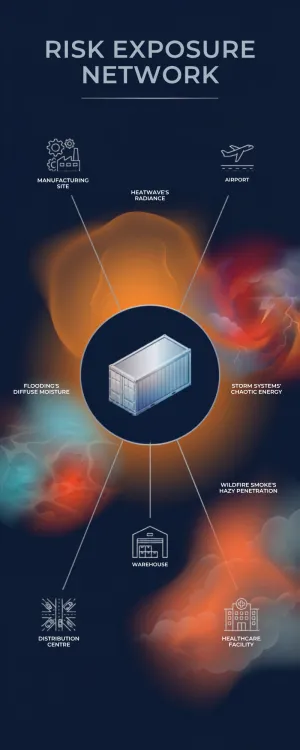
Pharmaceutical supply chains have primary reasons why temperature excursions occur during extreme weather events like heatwaves. These are inadequate packaging selection, transit delays caused by weather disruption, and the absence of real-time monitoring.
Each of these failure modes is directly relevant to the conditions Europe's pharma supply chains are navigating today.
Route disruption is a factor that receives less attention than equipment failure but is equally material. Flooding, road closures, and the operational slowdowns that accompany extreme heat affect transit times and therefore the duration for which products must maintain temperature integrity.
A container validated for a 48-hour transit may face a 72-hour journey if infrastructure is disrupted, placing its thermal performance assumptions under stress they were not designed to accommodate.
Find out how Quality-by-Design improves reliability and compliance in pharma and how you can maximise innovation through quality-based pharma development systems.
Image
What Pharma Supply Chain Leaders Must Address Now
The immediate priority is data visibility.
Pharma organisations that lack real-time temperature monitoring across their distribution network cannot assess their current exposure.
Data loggers and IoT-enabled monitoring systems that provide continuous temperature records throughout transit are extremely important in pharma supply chain. They are the minimum standard required to detect, document, and respond to excursions before they become regulatory incidents.
Packaging qualification must reflect the actual environment, not the modelled one.
Thermal packaging validated against standard ambient profiles may not perform adequately when ambient temperatures are 15 degrees Celsius above seasonal averages for five or more consecutive days.
The assumption that distribution infrastructure will maintain standard operating conditions during a European summer can no longer be made.
Qualification testing should incorporate worst-case ambient profiles consistent with the conditions that are now occurring with increasing frequency.
Active system dependency in high-risk markets needs to be reviewed.
Any pharma medicines facility or transit route operating active refrigeration in a geography that has experienced grid instability during the current heatwave should be assessing whether passive contingency solutions are in place.
A power outage of four hours affecting an unmonitored active cold store is a patient safety event; a power outage of 12 hours in a region under a red heat alert may be a batch recall.
Climate scenario planning must inform logistics strategy.
The 2026 heatwave is the second severe event in Europe in two months, following an exceptional May heat episode.
Supply chain resilience frameworks that have not been updated to account for the increasing frequency and intensity of extreme heat events are operating on outdated risk assumptions.
Image
The Strategic Position for Pharmaceutical Leadership
Cold chain integrity during extreme weather is not a logistics department problem. It is a patient safety matter, a regulatory obligation, and a significant financial risk that sits at the intersection of climate change, infrastructure reliability, and supply chain design.
The conditions across Europe in June 2026 are demonstrating in real time that the assumptions built into many pharmaceutical distribution models are no longer conservative enough.
Organisations that emerge from this period with their product integrity intact will be those that invested in monitoring, passive pharma cold chain contingency systems, and climate-resilient logistics design before the temperature records were broken. The cost of that investment is a fraction of a single major excursion event.
At Pharmatica, we track the operational, regulatory, and strategic forces shaping pharmaceutical supply chains globally. Our analysis connects emerging climate risk to the decisions that protect product integrity, patient safety, and commercial resilience across the life sciences sector.
Pharmatica: Insight. Connection. Impact.
Frequently Asked Questions
What is a pharmaceutical cold chain temperature excursion?
A temperature excursion occurs when a medicine is exposed to conditions outside its specified storage range at any point during manufacturing, transit, or storage.
The CDC defines it as any reading outside the range stated in the manufacturer's package insert. Even brief excursions can degrade biologics, vaccines, and injectable therapies, reducing efficacy or creating safety risks for patients.
Why does extreme heat specifically threaten pharmaceutical supply chains?
High ambient temperatures accelerate the chemical degradation of medicines through increased rates of oxidation and hydrolysis. For every ten-degree Celsius rise in temperature, these reactions increase exponentially.
Active refrigeration systems also become less efficient under sustained heat load, and power grid stress during heatwaves creates blackout risk that can interrupt cold storage entirely, turning an equipment challenge into a full supply chain incident.
How does the current European heatwave affect pharmaceutical distribution?
The June 2026 heatwave has placed multiple European countries under red alerts, with temperatures 14 to 18 degrees Celsius above seasonal averages.
Grid operators in France and Spain have warned of blackout risk from surging electricity demand. Italy has already experienced heat-related power outages in Turin.
For any distribution node using active refrigeration, unplanned power loss during this period represents a material risk to product integrity and regulatory compliance.
What is the difference between active and passive pharma cold chain systems?
Active pharma cold chain systems use electrical power to maintain temperature through mechanical refrigeration. They are flexible and adjustable but depend on continuous power supply.
Passive pharma cold chain systems use phase change materials to absorb and release heat without electricity, maintaining temperature ranges for extended periods regardless of power availability. Passive systems offer greater resilience during infrastructure disruptions but require precise upfront qualification for each product and shipping profile.
What should pharmaceutical supply chain executives prioritise during extreme heat events?
The immediate priorities are real-time temperature monitoring across the distribution network, review of packaging qualification assumptions against actual ambient conditions, assessment of active system power dependency in high-risk regions, and contingency logistics planning for route disruptions caused by weather and infrastructure failure.
Longer-term, climate scenario planning should be integrated into supply chain resilience frameworks to account for the increasing frequency of events of this scale.
Nicole (BSc Molecular Medicine, Honours Medical Biochemistry) has many years of pharmaceutical experience, having worked for top CROs and biopharma companies for more than a decade.
Did you enjoy the content?
3
Why not support
Nicole Dale
by giving this content a like
Good Laboratory Practice Always Sets the R&D Standard
Good Laboratory Practice strengthens data integrity, reproducibility, and regulatory confidence across pharma non-clinical R&D and preclinical research.
Seven Ways AI Is Solving Pharmaceutical Supply Chain Problems
AI is tackling the pharmaceutical supply chain's most persistent problems, from demand forecasting to counterfeit detection. See the top 7 ways AI is improving supply chain resiliency.
The Looming Threat of Geopolitical Risk in Clinical Supply Chains
Geopolitical risk is reshaping how clinical supply chains are managed, demanding resilience and foresight. Learn why building supply chain resilience is the key for clinical trial success.
Healthcare Supply Chains in Africa: Lessons from COVID-19
COVID-19 exposed major weaknesses in pharmaceutical supply chains. In this episode of Chain Reaction, Trisha Pillay and Émile Malan explore how AI, regulatory reform, and local manufacturing could strengthen healthcare resilience.














Comments (0)