Discover how hidden dependencies, single-source suppliers, and cold-chain disruption threaten supply chain resilience and essential medicine availability.
Pharmaceutical supply chain resilience depends on more than reliable transport and adequate inventory.
Hidden dependencies on single-source suppliers, critical raw materials, temperature-controlled logistics, and vulnerable trade routes can turn a minor operational failure into a serious essential medicine shortage.
Image
The Supply Chain’s Hidden Weak Points
A pharmaceutical supply chain can appear robust while depending on a surprisingly small number of critical suppliers.
A finished essential medicine product may have several distribution routes, yet rely on one source of an active pharmaceutical ingredient (API), one specialist intermediate, or one facility capable of performing a critical manufacturing step.
These dependencies are difficult to see when risk assessments focus mainly on direct suppliers. The real vulnerability may sit several tiers upstream, beyond the supplier with which the manufacturer has a direct relationship.
The consequences are real. The U.S. Food and Drug Administration’s analysis of drug shortages identifies manufacturing quality, limited production capacity, and weak incentives to maintain reliable supply as important structural factors. A supplier failure can therefore expose a problem that already exists within the wider market.
The critical question is not simply who supplies a medicine, but what must remain available for that medicine to be made.
When one supplier becomes a single point of failure
Single-source supply is not always a mistake. Some ingredients require specialised manufacturing expertise, and qualifying an alternative supplier can demand significant technical work, regulatory assessment, and investment.
Maintaining multiple suppliers for every material may also be commercially unrealistic.
The danger arises when a company treats a necessary dependency as though it were a manageable one without testing that assumption.
A supplier may depend on one upstream chemical producer, one manufacturing site, or one transport route. A second supplier may appear to offer redundancy but purchase the same critical material from the same upstream source. On paper, the manufacturer has two options. In practice, both may fail together.
Pharmaceutical leaders should distinguish supplier count from genuine supply diversity. Effective mapping needs to identify the material, manufacturing site, upstream origin, available capacity, and realistic time required to activate an alternative.
This is particularly important for older medicines with limited commercial margins. The FDA has highlighted how concentrated production capacity and restricted raw-material availability can make certain sterile injectable products difficult to replace quickly when a manufacturer encounters problems.
The small failure with a large consequence
Supply disruptions rarely respect organisational boundaries. A delayed chemical shipment can interrupt API production. That delay can hold up a finished-dose manufacturer, which may then miss delivery commitments to several markets.
A seemingly minor component can create the same effect.
Packaging materials, specialist filters, stoppers, or other production inputs may be essential to releasing a finished product. If a required item is unavailable or fails quality checks, a facility may have to delay operations even when its main ingredients are in stock.
The resulting shortage can reflect a chain of dependencies rather than a single dramatic incident.
Pharmatica’s Insights into integrated pharmaceutical operations and supply chain management examines why forecasting, production, inventory, procurement, and logistics need to operate as a connected system.
For resilience planning, that means tracing how one interruption propagates across the network, not merely recording the initial supplier failure.
Find out how Quality-by-Design improves reliability and compliance in pharma and how you can maximise innovation through quality-based pharma development systems.
How Geopolitics and Cold Chains Turn Risk Into Disruption
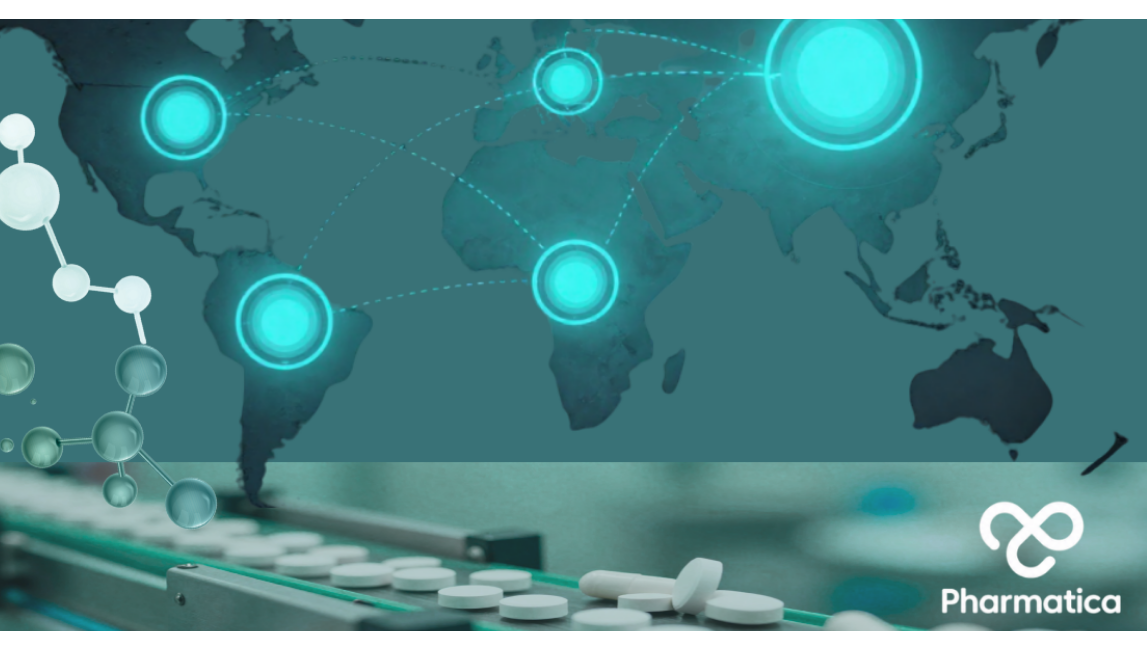
A supply chain can be vulnerable even when every supplier performs as expected. Conflict, border restrictions, port congestion, energy shortages, extreme weather, and sudden changes in freight availability can disrupt the infrastructure that connects them.
Geographic concentration increases the exposure. If several critical materials originate in the same region, a local crisis can affect multiple products at once. If those materials travel through the same maritime chokepoint, different suppliers may share the same logistical weakness.
Pharmaceutical companies cannot remove geopolitical risk from global trade. They can, however, identify where a disruption would have the greatest operational effect.
The organisation’s analysis reinforces a practical point: Visibility into the wider network is essential when companies need to identify which dependencies matter most.
Image
The route that cannot be replaced overnight
Closures around the Strait of Hormuz provides a useful illustration of how a geopolitical event can affect pharmaceutical operations beyond the immediate shipping route.
Disruption can raise freight and insurance costs, extend transit times, and affect the availability of energy and petrochemical inputs used further upstream.
A medicine does not need to be aboard a delayed vessel to face supply risk. Its production may depend on a precursor, solvent, packaging component, or other input affected by the same disruption.
Pharmatica has examined these connections in our Insights. For manufacturing and supply teams, the lesson is to assess exposure by material and route, then test whether alternative sourcing and transport arrangements would work under real conditions.
When the cold chain breaks
Temperature-controlled medicines introduce another vulnerability.
Biologics, vaccines, and other sensitive products may require defined conditions during storage and transport. A temperature excursion can trigger quarantine, investigation, and a decision on whether the affected stock remains suitable for use.
The risk extends beyond a refrigeration failure. Delays at borders, power interruptions, equipment faults, inadequate packaging, and poor handovers can all threaten temperature control.
Even when a product remains physically intact, missing or unreliable monitoring records can complicate the assessment of its condition.
Cold-chain resilience therefore depends on more than refrigerated vehicles. It requires qualified packaging, suitable storage, continuous or appropriate temperature monitoring, clear escalation procedures, trained logistics partners, and contingency arrangements for delays.
Pharmatica’s Insights into cold-chain optimisation in pharmaceutical logistics explores the operational trade-offs involved. The central issue is whether the network can preserve product quality when actual conditions differ from the plan.
A delivery arriving late is an operational problem. A delivery arriving with uncertain product quality is also a quality and patient-safety problem. The response must reflect both.
GMP and Manufacturing Continuity Must Work Together
Good Manufacturing Practice (GMP) protects product quality through controlled processes, qualified equipment, appropriate documentation, and effective quality systems.
These requirements are essential to reliable supply, but they can also limit how quickly a manufacturer can respond when a critical input or production site becomes unavailable.
An alternative material cannot simply be substituted because it is in stock. Its suitability must be assessed, and the relevant quality and regulatory requirements must be met.
Changes to suppliers, sites, materials, or manufacturing processes may require technical evaluation and, depending on the change, regulatory action before implementation.
That is why contingency planning must begin before disruption occurs. A backup supplier that has not been technically assessed and qualified may not be a usable backup when production stops.
Build continuity into the operating model
Manufacturers need a risk-based approach that reflects product criticality, supplier concentration, material lead times, available inventory, and the time needed to restore production.
Not every component requires the same level of protection. A shortage of a readily available secondary material presents a different risk from the loss of a specialised API with a long replacement lead time.
Useful continuity measures include:
Map critical dependencies: Identify essential materials, upstream suppliers, manufacturing locations, logistics routes, and shared points of failure.
Test alternative supply: Assess whether a second source has suitable capacity, technical capability, quality controls, and the necessary regulatory status.
Set risk-based buffers: Match inventory and safety-stock decisions to replenishment times, product criticality, and the consequences of interruption.
Prepare disruption scenarios: Model supplier shutdowns, transport delays, cold-chain excursions, energy shortages, and sudden demand increases.
Connect quality and operations: Ensure procurement, quality assurance, regulatory affairs, manufacturing, and logistics can make coordinated decisions when a disruption occurs.
These measures should form part of any sponsor’s quality and business continuity systems rather than sit in a separate emergency document.
Traditional supply metrics remain useful, but they do not reveal the full strength of a supply network.
Supplier on-time delivery, inventory levels, and manufacturing performance describe current operations. They do not necessarily show how long the company could maintain supply after losing a critical source.
Teams should also assess recovery time, alternative-source readiness, the concentration of upstream dependencies, and the number of products exposed to a shared failure.
Scenario exercises can reveal whether teams have enough information and authority to respond before inventory is exhausted.
Digital monitoring can support earlier detection, provided the data is reliable and teams know what action to take. Visibility without clear accountability merely makes a developing problem easier to observe.
The Looming Threat of Geopolitical Risk in Clinical Supply Chains
Geopolitical risk is reshaping how clinical supply chains are managed, demanding resilience and foresight. Learn why building supply chain resilience is the key for clinical trial success.
Image
Building Supply Chain Resilience Before the Alarm Sounds
The phantom in the supply chain is not a mysterious force. It is the dependency that remains unnoticed because each team sees only part of the system.
It may be a single-source raw material, a shared transport route, a fragile cold chain, or a qualified manufacturing step that cannot be replaced quickly.
The answer is not to duplicate every supplier or stockpile every component but rather to understand where failure would have the greatest impact, invest in credible alternatives, and make continuity a shared responsibility across technical operations, quality, procurement, regulatory affairs, and logistics.
For manufacturing and supply teams, resilience is demonstrated by the ability to maintain quality and supply when assumptions fail, not by the existence of a contingency plan.
At Pharmatica, we examine the systems, strategies, and technologies shaping pharmaceutical manufacturing and supply chain resilience. Our Insights connect operational risk, quality, and manufacturing continuity to the decisions that help protect reliable access to medicines.
Pharmatica: Insight. Connection. Impact.
Frequently Asked Questions
What is pharmaceutical supply chain resilience?
Pharmaceutical supply chain resilience is the ability to anticipate, withstand, respond to, and recover from disruptions while maintaining medicine quality and availability. It depends on supplier diversity, upstream visibility, manufacturing flexibility, appropriate inventory, and effective coordination.
Why are single-source suppliers a risk for pharmaceutical manufacturers?
Single-source suppliers can create a point of failure when no qualified alternative can provide a critical material or service. Risk increases when the supplier also depends on a concentrated upstream source, has limited capacity, or requires a long lead time to restore supply.
How can geopolitical disruption cause medicine shortages?
Geopolitical disruption can affect shipping routes, border access, energy costs, freight availability, and the supply of raw materials or chemical precursors. These effects can delay production even when the finished medicine is manufactured far from the original disruption.
Why is cold-chain integrity important in pharmaceutical logistics?
Cold-chain integrity helps maintain the required storage and transport conditions for temperature-sensitive medicines. Temperature excursions, delayed shipments, equipment failures, or incomplete monitoring records may lead to quarantine, product assessment, or loss of usable stock.
How can GMP support pharmaceutical manufacturing continuity?
GMP supports consistent product quality through controlled processes, qualified materials, documentation, and quality oversight. Continuity planning complements GMP by preparing manufacturers to assess alternatives, manage disruptions, and restore supply without bypassing required quality or regulatory controls.
Nicole (BSc Molecular Medicine, Honours Medical Biochemistry) has many years of pharmaceutical experience, having worked for top CROs and biopharma companies for more than a decade.
Did you enjoy the content?
0
Why not support
Nicole Dale
by giving this content a like
FDA 2026 Draft Guidance on Alternatives to Animal Testing
The FDA's March 2026 draft guidance on alternatives to animal testing marks a pivotal shift in preclinical drug development. Here's what pharma R&D teams need to know.
Optimising Preclinical Pharmacology for Oncology NMEs
Over 90% of oncology NMEs that succeed in animal studies fail in clinical trials. This analysis examines how to optimise preclinical pharmacology models to improve translational success.
Success for Non-Animal Testing of Preclinical Toxicity?
Can non-animal testing methods be used in preclinical drug discovery? Here is what the evidence is for their accuracy and limits assessing preclinical toxicity.
Good Laboratory Practice Always Sets the R&D Standard
Good Laboratory Practice strengthens data integrity, reproducibility, and regulatory confidence across pharma non-clinical R&D and preclinical research.












Comments (0)